
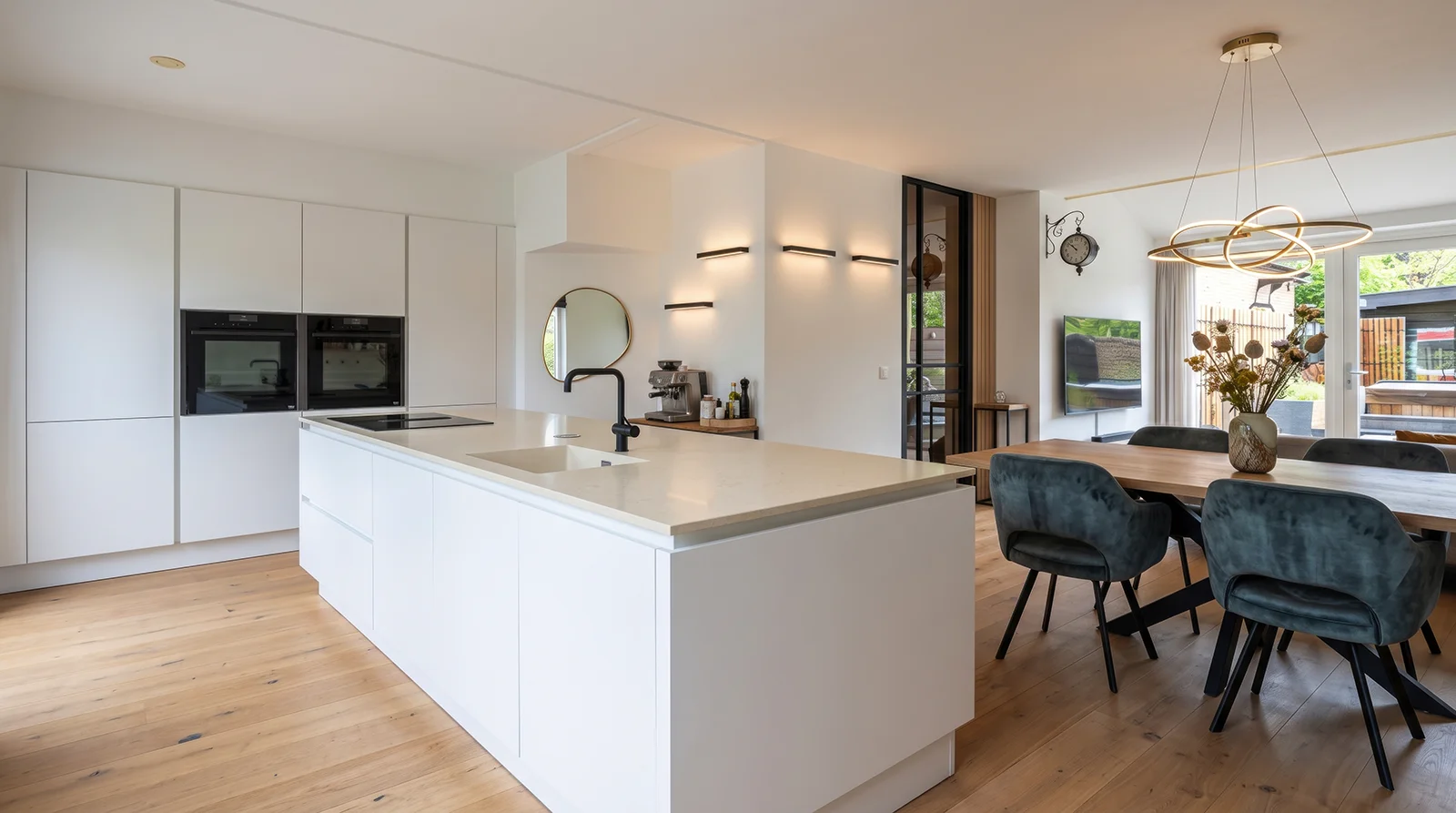
A Clear Price Breakdown from Budget to Luxury
What does a keukenrenovatie actually cost in the Netherlands right now? From a simple refresh to a full high-end overhaul, here is a realistic look at the numbers that matter in 2026.
Ask any Dutch homeowner what a kitchen renovation costs and you will hear a range so wide it can feel unhelpful. Some people manage a fresh look for a few thousand euros. Others spend the equivalent of a small car and still feel they could have gone further. The truth sits somewhere in the middle, and it depends less on vague categories than on a handful of concrete choices.
The published Dutch price guides for 2026 do not agree with each other either, which is worth knowing before you take any single figure as gospel. Homedeal puts the average complete kitchen at €7,000 to €15,000 including fitting and appliances, with simple kitchens starting around €5,000. Other 2026 overviews land at €12,000 to €20,000, and showroom-led estimates at €15,000 to €25,000. Taken together, most households replacing a whole kitchen end up somewhere between €10,000 and €25,000. Budget projects stay under €12,000. Luxury custom work with structural changes and premium appliances starts around €25,000 and climbs from there. Those figures cover cabinets, worktops, appliances and basic installation, but they hide extras that often surprise people once the work starts.
What actually drives the price
A kitchen is not a single product. It is a collection of decisions stacked on top of one another. The cabinets and fronts usually account for 30 to 45 percent of the total. Appliances take 20 to 35 percent, more if you choose premium brands. The worktop sits between 10 and 20 percent, depending on material. Installation and labour typically add 10 to 15 percent, though that rises quickly if pipes, electrics or the layout itself need moving. The shares move against each other, so a kitchen at the top of one band will usually sit at the bottom of another.
Length matters. Dutch suppliers and installers often price by the running metre. A modest straight kitchen of three to four metres sits at the lower end of every range. An L-shaped or U-shaped layout of five or six metres moves into the middle. Add an island and the numbers jump again because of extra cabinetry, additional plumbing and electrical work, and more complex installation.
Location has a measurable effect too. One Dutch pricing index puts the regional spread in labour rates at roughly three percent above the national level in smaller cities and up to fifteen percent in Amsterdam and Utrecht. On a €20,000 project that difference alone is worth more than a dishwasher.
Budget work under €12,000
A true budget approach keeps the existing layout and focuses on what people see and touch every day. New fronts and handles on the existing carcasses, a fresh laminate or simple composite worktop, and a set of reliable but not premium appliances can transform the room without touching the walls or floor. Many households achieve this for €5,000 to €9,000, sometimes a little more if they replace the flooring or add basic lighting. If the carcasses are still square and dry, refacing rather than replacing can bring the whole job in at €2,000 to €8,000, because the layout and the pipework stay exactly where they are.
IKEA-style systems and entry-level packages from larger Dutch kitchen chains sit comfortably in this band when the layout stays the same. The trade-off is longevity and flexibility. Budget materials perform well for daily life but show wear sooner, and future changes are harder if the carcasses are not designed for easy upgrades.
The mid-range reality, €12,000 to €25,000
This is where most Dutch renovations settle. New cabinets in better materials, a durable composite or quartz worktop, built-in appliances from established brands, and professional installation produce a kitchen that feels solid and looks intentional. For a typical five- to six-metre L-shaped kitchen the total often lands between €15,000 and €22,000 once everything is included.
At this level you begin to see the difference in daily use. Soft-close drawers, better hinges, quieter extraction and more thoughtful storage make cooking less of a compromise. Many people also replace the floor and update the splashback, costs that sit outside the pure kitchen package but are hard to ignore once the old surfaces are gone. A tiled splashback runs roughly €500 to €1,500 fitted, glass panels more.
Luxury and custom from €25,000
High-end kitchens move into different territory. Custom cabinetry, natural stone or advanced ceramic worktops, premium appliances, integrated lighting, and often a change of layout or the addition of an island push the total into the €25,000 to €40,000 range and higher. Structural work – moving walls, relocating services, reinforcing floors for heavier stone – adds further cost that is easy to underestimate at the planning stage.
Structural change also brings paperwork. Removing or opening up a load-bearing wall needs a structural calculation and normally an omgevingsvergunning for the technical building activity, and in an apartment the VvE has to agree separately. Applying for that permission and notifying the municipality or the VvE is the homeowner’s responsibility, so it belongs in the timeline from the first sketch rather than the week the demolition is booked.
These kitchens are less about basic function and more about the room as a living space. The numbers reflect that ambition. They also reflect the reality that labour and specialist materials have risen steadily; what felt expensive five years ago now sits closer to the middle of the luxury band.
What the price includes and where VAT sits
Consumer prices in the Netherlands are quoted including 21 percent VAT, and kitchen work does not qualify for the reduced rate. The 9 percent tariff is limited to painting, plastering, wallpapering and insulating in homes older than two years. Fitting cabinets, worktops and appliances, tiling, flooring and pipework all sit at 21 percent.
There is one useful exception. Where a project includes plastering the walls before the units go in, that part of the invoice can legitimately be billed at 9 percent, materials included. It only works if the quotation splits the trades out rather than presenting a single lump sum, which is one more reason to ask for an itemised offer.
The costs that rarely appear on the first quote
Demolition and disposal of the old kitchen usually adds a few hundred to around a thousand euros. Moving water, waste or electrical points can easily add €700 to €2,500 depending on the distance and complexity. A new group in the meter cupboard for induction is common and not free; an electrician adding groups or relocating connections typically charges €300 to €800, and a plumber connecting tap and dishwasher €200 to €500. Flooring, tiling, painting and making good after the installers leave are almost always separate line items.
In houses built before 1994, stripping out an old kitchen can uncover asbestos in floor tiles, bitumen adhesive or wall panels. An inventory by a certified firm, and certified removal if anything is found, are separate costs and can push the schedule back by days. Worth establishing before demolition day rather than during it.
A sensible buffer of 10 to 15 percent on top of the main kitchen package is the practical way to avoid the familiar late-project stress. Labour rates for specialists sit in the range most people expect for skilled trades in the Netherlands, but the hours add up once the scope expands beyond a simple swap.
How to keep control of the numbers
The most reliable approach is to decide the non-negotiables first. Layout and appliances tend to drive the biggest jumps. Keeping the existing footprint and focusing money on a better worktop and quieter, more efficient appliances often delivers more daily satisfaction than spreading the budget thinly across every surface.
Compare at least three detailed quotes that break out cabinets, worktop, appliances and installation. Ask specifically about what is excluded. Many Dutch suppliers run promotions that cut list prices significantly; the final negotiated figure is often more useful than the brochure price.
And remember that a kitchen is used every day for years. Spending a little more on hinges, drawers and extraction that work smoothly can matter more in practice than a dramatic visual statement that proves awkward to live with.
A realistic view for 2026
There is no single correct price for a kitchen renovation in the Netherlands. There is a clear pattern. Budget refreshes remain possible for under €12,000 if the layout stays put. Most complete mid-range projects settle between €12,000 and €25,000. Luxury custom work starts around €25,000 and climbs according to ambition and structural complexity.
The useful question is not “what does a kitchen cost?” but “what do we actually need this room to do, and which elements deliver that every single day?” Answer that honestly and the numbers become clearer, the choices more deliberate, and the finished kitchen more likely to feel worth the investment.
LucKey Construction quotes kitchen work line by line across Zaandam, Amsterdam and the wider region, separating cabinetry, pipework, electrics and finishing so the 9 and 21 percent portions are visible, as part of broader house renovation projects. Which permissions a job is likely to need is flagged at the quotation stage. Submitting them stays with the homeowner.
Disclaimer: the prices in this article are national market indications for 2026, drawn from published Dutch price guides and observation of the Amsterdam region. They are not a quotation, a price list or an offer, and no figure here can be relied on as a richtprijs for any particular project. Actual cost depends on the property, the layout, the condition of the existing pipework and electrics, the brands chosen and the region. LucKey Construction sets a price only after a property visit and a full calculation, and that figure is the one that applies. Labour rates and material prices change, and the figures here reflect the position in August 2026.