
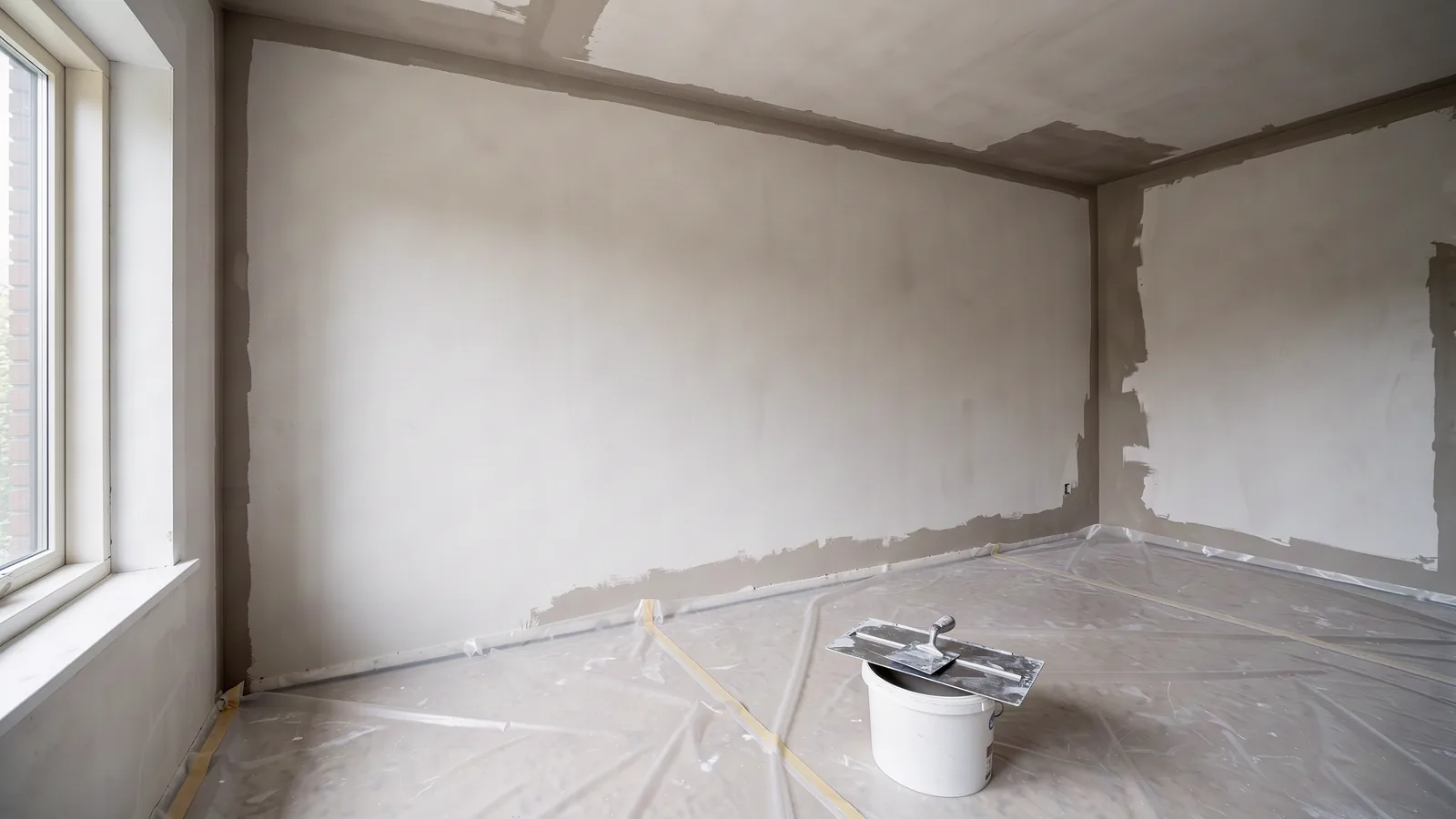
What plastering costs per square metre in 2026
Starting prices for walls and ceilings by finish, the lines a quote adds on top of the square-metre rate, and a living room worked through. The Dutch guides disagree by a few euros per metre; the gap between a cheap quote and a realistic one is mostly preparation.
A smooth, paint-ready plastered wall starts at €18 per m² in 2026, according to both Trustoo and Homedeal. A wallpaper-ready wall starts lower, from €8 per m² in the cheapest guide. Ceilings start level with walls or a few euros above them, and a sprayed spack ceiling, the cheapest way to finish one, starts at €6 per m². Those figures cover the plastering and the plaster. Removing what is already on the wall, priming, corner profiles, masking and small-job minimums are priced separately, and in the living room worked through below they add about 40 percent.
Starting prices by finish, in three guides
Trustoo (updated August 2026), Homedeal (February 2026) and Offerteadviseur (April 2026) each publish their own figures. Trustoo and Homedeal say theirs include materials and VAT. Offerteadviseur does not say.
| Finish | Trustoo | Homedeal | Offerteadviseur |
|---|---|---|---|
| Spack spray (spackspuiten) | from €7 | from €9 | from €6 |
| Wallpaper-ready wall (behangklaar) | from €8 | from €14 | from €10 |
| Paint-ready wall (sausklaar) | from €18 | from €18 | from €10 |
| Ceiling, smooth | from €18 | from €20 | from €15 |
| Levelling coat (raapwerk) | from €15 | from €15 | from €20 |
| Decorative plaster (sierpleister, spachtelputz) | from €22 | from €20 | from €18 |
Offerteadviseur gives wallpaper-ready and paint-ready walls as one line, which is why its paint-ready figure sits so far below the other two. Elsewhere the gaps come from what each guide counts as the job: a smooth wall on sound gypsum and the same wall over cracked old plaster are not the same work.
Behangklaar, sausklaar and the alternatives
Wallpaper-ready plaster is slightly rougher and is meant to be covered by wallpaper or decorative plaster. Homedeal warns that paint does not hold well on it, so a wall that will be painted needs the paint-ready finish. Smooth machine plaster of the MP75 type is the standard finish in Dutch living rooms and bedrooms.
Spackspuiten is the budget option for ceilings. Sprayed on by machine, it leaves a light grain rather than a flat surface and is popular on large areas and in new-build homes. Trustoo describes it as suited to a smooth base without cracks. It comes in white by default; a colour can be mixed in during spraying, so the ceiling needs no paint, for a surcharge Homedeal puts at €2 per m² on average.
Decorative plaster is synthetic-based and tougher against knocks. Spachtelputz has a grain of 1 to 2.5 mm, granol is the coarsest with grooves of 3 to 4 mm. Beton ciré is a different product priced differently: from €45 per m² at Homedeal and from €60 at Trustoo and Offerteadviseur, because it is skilled hand work.
Why a ceiling costs more than a wall
The plasterer works overhead, which is heavier and slower, and all three guides give that as the reason. Homedeal adds recessed lighting and ornaments. Trustoo puts the average difference at €5 or more per m², Homedeal at €5 on average.
Above 3 m a scaffold or work platform is needed, and Trustoo prices that as a surcharge from €5 per m². A ceiling with exposed beams costs from €33 per m² extra. A damaged, uneven or mouldy ceiling needs repair before plastering, from €5 per m² on top (Homedeal).
What the square-metre price leaves out
- Removing wallpaper: from €5 per m² for one layer of paper, from €8 for vinyl, from €12 for glass-fibre or renovlies, and from €3 per m² for each extra layer (Offerteadviseur).
- Removing old plaster: from €25 per m² done professionally (Homedeal, 2025 figure).
- Priming (voorstrijken): from €2 per m² at Trustoo and Offerteadviseur, from €4 at Homedeal. Needed on absorbent walls and where old wallpaper is still on.
- Corner profiles: from €5 per running metre on external corners, door openings and window reveals (Trustoo).
- Cracks reinforced with gauze or tape: from €5 per m² (Offerteadviseur).
- Masking and waste removal: from €2.75 per m² (Trustoo).
An uneven wall needs a levelling coat before the finish, at the raapwerk rates in the table above. That line alone can nearly double the cost of a wall.
Hourly rates, day rates and the small-job minimum
Trustoo says plasterers price almost everything per m² or as a fixed sum, and use an hourly rate mostly for small repairs. Where one is quoted, it starts at €30 an hour at Trustoo, €35 at Offerteadviseur and €40 at Homedeal. A day rate starts at €400 at Trustoo.
The rate that matters for a small job is the minimum. Trustoo and Homedeal both start the minimum fee at €290, and Trustoo applies it below 25 to 30 m². One 9 m² wall at €18 works out at from €162, so the minimum applies. Homedeal notes that the price per m² drops noticeably from about 30 m², an argument for doing two rooms at once.
Worked example: a living room, walls and ceiling
A living room of 6 by 4 metres with a ceiling height of 2.6 m. The ceiling is 24 m². The walls are 20 m of perimeter times 2.6 m, or 52 m², less 6 m² for a window and two doors, which leaves 46 m². The walls are sound and get a paint-ready finish. Rates are Homedeal’s for plastering and priming, Trustoo’s for profiles and masking.
- Walls, paint-ready: 46 m² × €18 = from €828
- Ceiling, smooth: 24 m² × €20 = from €480
- Priming: 70 m² × €4 = from €280
- Corner profiles on the window reveal: 8 m × €5 = from €40
- Masking and waste: 70 m² × €2.75 = from €192.50
Total: from €1,820.50, or €26.01 per plastered m². That is about 40 percent more than the plastering lines alone. Trustoo’s own living room scenario, with 55 m² of wall and 20 m² of ceiling, starts at €1,350 because it prices the plastering only. Offerteadviseur starts a living room with walls and ceiling at €1,200.
Old wallpaper on those walls adds from €230 (46 m² × €5). A ceiling higher than 3 m adds from €120 (24 m² × €5). Cracks, a levelling coat or old plaster that has to come off each add their own line on top.
Drying time before painting
The guides measure this differently. Trustoo says plaster needs 24 to 48 hours before it can be painted or papered, longer for a thick levelling coat. Homedeal uses a rule of thumb of about a day per millimetre of thickness, and treats the plaster as ready once it has turned an even, light colour. Trustoo adds that winter slows drying considerably and that drying too fast in summer heat causes shrinkage cracks. The painter primes fresh plaster before the first coat, which is why plastering and painting are planned as one sequence.
VAT: 9 percent, materials included
Plastering a home older than two years carries 9 percent VAT. The Belastingdienst counts the two years from the date the property was first used as a home, and the reduced rate covers the preparation, the pre-treatment and the materials used, not only the labour. Work that stands too far from plastering stays at 21 percent; the Belastingdienst’s own examples are putting up plasterboard walls, tiling walls and laying floors.
Trustoo and Homedeal quote their prices with 9 percent included. In a home younger than two years the rate is 21 percent, which raises a VAT-inclusive figure by about 11 percent. Our article on the 9 percent rate covers the other trades, and the per-m² renovation guide puts plastering in the context of a wider project.
Questions that come up at the quote
Can new plaster go over the old layer?
Usually, Homedeal says, as long as the old layer is still firmly attached. Loose parts come off first and an adhesion primer goes on before the new coat.
Is plastering dearer in Amsterdam?
Homedeal puts rates in urban areas, especially the Randstad, about 10 percent higher than elsewhere. Both Trustoo and Homedeal note that prices can rise in spring and summer, the busiest months.
What changes in a house built before 1994?
Asbestos could be used in Dutch building materials until January 1994. Before work that opens up ceilings or walls in such a house, have it checked: Milieu Centraal notes that asbestos can sit in ceiling boards or behind later finishes such as a lowered ceiling.
Does a bathroom take the same plaster?
No. Standard gypsum plaster is not suited to wet rooms; cement-based or moisture-resistant systems are used instead, and a bathroom renovation is priced on its own terms.
LucKey Construction plasters walls and ceilings across Zaandam, Amsterdam, Haarlem and the surrounding towns, from smooth paint-ready finishes and levelling coats to decorative plaster and local repairs after a leak or new cabling, with exclusions written out and the 9 and 21 percent VAT portions shown separately. The work carries a one-year guarantee. See plastering services, or ask for a quote.
Disclaimer: every figure in this article is a starting point, not a price and not a ceiling. They are national market indications for 2026, drawn from published Dutch price guides and observation of the Amsterdam region, and they describe where work of this kind begins when nothing unusual is found. They are not a quotation, a price list or an offer, and no figure here can be relied on for any particular project. What the work actually costs depends on the property, the size and height of the rooms, the condition of the existing walls and ceilings, the finish chosen and the region, and it is fixed only in a written quotation after a property visit and a full calculation. That quotation is the only figure that binds anyone. Labour rates and material prices change, and the figures here reflect the position in October 2026. Rules on permits, subsidies and VAT change: check anything here that affects a permit, a subsidy or a tax rate with the body responsible for it, which means your municipality and the Omgevingsloket for permits, RVO for the ISDE, and the Belastingdienst for VAT. Responsibility for permits and applications rests with the homeowner, not with the contractor.