
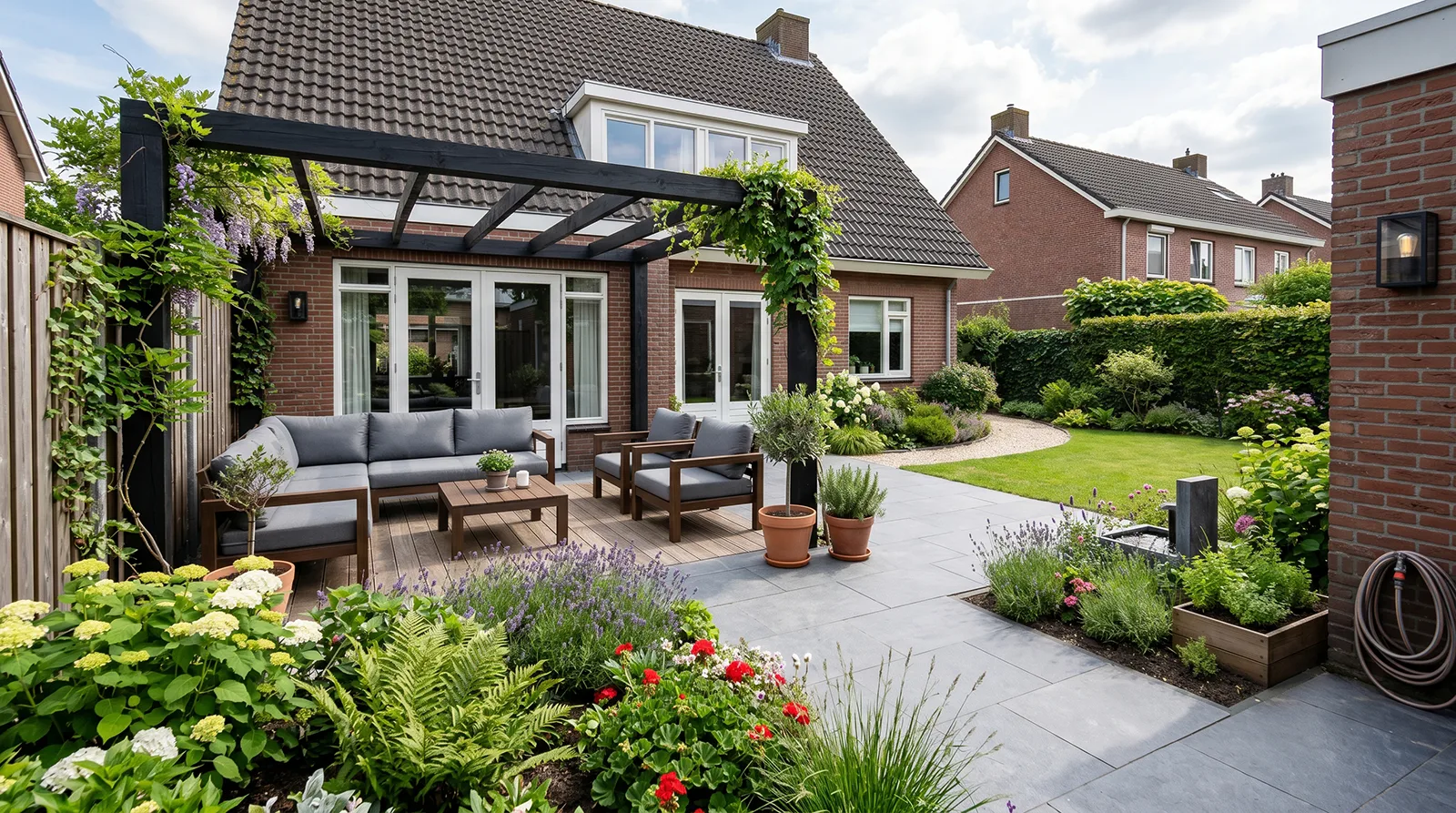
Patio renovation in the Netherlands demands more than aesthetic choices. In a country where rain is a year-round fact and frost arrives without warning, the materials you choose and how you handle drainage will determine whether your patio lasts or needs redoing in five years.
There’s a particular optimism that comes with owning a garden in the Netherlands. You look at your patio – perhaps tired concrete slabs laid by a previous owner, perhaps a wooden deck slowly turning green with algae – and imagine something better. A place to sit with coffee on a spring morning. Space for friends and a barbecue on those summer evenings that make you forget about the other 300 days of the year.
The vision is clear. The execution, in the Dutch climate, requires more thought.
Renovating a patio here isn’t only about what looks good. It’s about what survives. What handles the rain, and there is a lot of rain. What doesn’t crack when temperatures drop below zero. What doesn’t become a skating rink when wet. And what lets water go where it needs to go instead of pooling against your back door or flooding your neighbours’ garden.
Get these things right, and you’ll have an outdoor space that works well for years. Get them wrong, and you’ll be doing it all over again sooner than you’d like.
The Dutch Climate and What It Does to Your Patio
The Netherlands has a maritime climate: mild but wet, with cool winters and warm summers. Annual rainfall averages 800–900mm, spread fairly evenly across the year. There is no dry season. Your patio will be rained on in January and rained on in July.
Frost is a regular winter visitor, though severity varies by year. Temperatures frequently drop below zero between November and March, and freeze-thaw cycles – where water gets into cracks and pores, freezes, expands, and breaks things apart – are the silent destroyer of poorly chosen patio materials.
Humidity is consistently high, which means moss, algae, and biological growth on outdoor surfaces are permanent facts of life. Any material that stays damp for long periods will, sooner or later, develop a green film. The question isn’t whether it will happen, but how quickly and how much maintenance you’re willing to do.
Wind is another factor, particularly in coastal provinces and open, flat landscapes – which is most of the country. Wind-driven rain hits surfaces at angles that standing water doesn’t, and it keeps surfaces perpetually damp in sheltered spots.
Understanding the Dutch climate is the first step in any successful patio renovation in the Netherlands. Material choice is, first and foremost, an engineering decision. The aesthetics matter – you have to want to look at it – but durability, frost resistance, slip resistance, and drainage behaviour come first.
Material Options for Patio Renovation in the Netherlands
Natural Stone
Natural stone looks good, ages well, and can last decades if you choose the right type. The category covers an enormous range of materials, and not all of them suit the Dutch climate.
Granite is the most robust option. It is extremely hard, highly frost-resistant, and virtually impervious to water absorption. It handles freeze-thaw cycles without complaint and comes in a range of colours and finishes. Flamed or bush-hammered granite gives good slip resistance when wet. The main drawbacks are weight – which may require a more substantial sub-base – and an appearance some find too austere for a garden setting.
Bluestone (Belgisch hardsteen) is a classic choice in the Low Countries and has been used for centuries in Dutch architecture. It is a dense limestone that handles the climate well, develops a good patina over time, and has a natural, understated look. It is reasonably frost-resistant, though not quite as durable as granite. Sawn finishes can be slippery when wet, so a tumbled or brushed finish is advisable.
Limestone and sandstone are more problematic. Many varieties are porous, absorbing water that then freezes and causes surface flaking or cracking (spalling). Some limestones and sandstones are sold as frost-resistant, and some genuinely are – but check the specific stone’s frost resistance rating rather than taking a supplier’s word for it. Indian sandstone, which has become popular across northern Europe, varies considerably in quality. Good grades perform well; the cheapest can deteriorate within a few winters.
Slate can work well – it is naturally water-resistant and has good slip properties – but it is prone to delamination if the quality is not high. Welsh and Brazilian slates tend to be more durable than cheaper alternatives.
Travertine and marble are poor choices for patio renovation in the Netherlands. Both are porous, frost-sensitive, and prone to staining. They look good in a Mediterranean courtyard; a Dutch winter will expose their weaknesses quickly.
Invest in quality, choose stone with proven frost resistance, and pay attention to the finish. A stone that becomes a liability after two winters is no bargain.
Concrete Pavers and Tiles
Modern concrete pavers and tiles have come a long way from the grey slabs of decades past.
Standard concrete pavers (betontegels) remain the most common patio surface in the Netherlands. They are frost-resistant, widely available, easy to lay, and easy to replace if individual units are damaged. They come in a wide range of sizes, colours, and textures, including convincing imitations of natural stone.
Porcelain-look concrete tiles have become increasingly popular, offering the look of ceramic or stone with the durability and frost resistance of high-quality concrete.
Permeable concrete pavers (waterdoorlatende bestrating) deserve special mention because they address one of the biggest challenges in Dutch patio renovation: drainage. These pavers allow water to pass through the surface into the sub-base below, reducing runoff and helping manage stormwater. More on this in the drainage section.
The main limitation of concrete is aesthetic – it does not age with the same character as natural stone, and over time it can show wear, fading, or efflorescence (white salt deposits on the surface). Quality varies considerably, and premium products hold up much better than budget options.
Ceramic Outdoor Tiles
Ceramic tiles designed for outdoor use – typically 20mm thick porcelain – have become a major trend in Dutch patio design over the past few years.
They come in an extraordinary range of designs, including highly realistic wood, stone, and concrete effects. They are extremely dense and non-porous, which makes them highly frost-resistant, stain-resistant, and easy to clean. Algae and moss struggle to take hold on their smooth, closed surface.
Check the slip resistance rating – R11 or higher is recommended for outdoor use. Ceramic tiles also require a very well-prepared, level sub-base. On an uneven surface, they crack under load.
Installation is more demanding than for concrete pavers. Outdoor ceramic tiles are typically laid on a compacted gravel and sand bed or on adjustable pedestal supports, not grouted onto a concrete slab as indoor tiles would be. Poor installation is the most common cause of problems with outdoor ceramic tiles.
Wood Decking
Wood decking brings warmth and a natural feel that hard paving cannot match. It works particularly well for raised patios, rooftop terraces, and areas where you want to create a distinct outdoor space.
Hardwood (hardhout) – tropical species like bangkirai (yellow balau), ipé, and massaranduba – is prized for its durability, natural resistance to rot and insects, and good appearance. It can last 20–30 years or more with proper maintenance. Always look for FSC-certified timber to ensure responsible sourcing.
Softwood (zachthout) – typically treated pine or Douglas fir – is more affordable but less naturally durable. Pressure-treated softwood can perform adequately in the Dutch climate, but it requires more frequent maintenance and has a shorter lifespan. Thermally modified wood (thermisch gemodificeerd hout), heat-treated to improve durability and stability, offers a middle ground.
Bamboo decking has emerged as an alternative, marketed as sustainable and durable. Compressed bamboo products can perform well, but quality varies and the market is still maturing.
Wood Decking Maintenance in the Dutch Climate
The universal challenge with wood decking in the Netherlands is moisture. Wood stays damp for long periods, promoting algae growth that makes surfaces slippery. Regular cleaning – with a pressure washer, scrub brush, or specialist deck cleaner – is essential. Anti-slip profiles or grooved boards help, but do not eliminate the problem.
Wood also expands and contracts with moisture changes. Proper gapping between boards and a well-ventilated substructure are critical. Boards laid too tightly will buckle; a substructure that does not allow airflow will trap moisture and accelerate rot.
Composite Decking
Composite decking – made from wood fibres and plastic polymers – has become a common alternative to natural wood. Modern composite is capped (wrapped in a protective polymer shell) that resists staining, fading, and moisture absorption. It does not splinter, needs no oiling or staining, and resists algae growth better than natural wood, though not completely.
The downsides: composite can feel slightly synthetic underfoot. It can also be slippery when wet, depending on surface texture. While it requires less maintenance than wood, it still needs cleaning, particularly in the damp Dutch climate.
There is also an environmental trade-off. Composite decking is often marketed as eco-friendly because it uses recycled materials, but the end product is difficult to recycle again at the end of its life. Worth considering if sustainability matters to you.
PVC Decking
PVC decking is made entirely from plastic. It is lightweight, moisture-proof, and very low-maintenance – it will not rot, warp, or absorb water.
It tends to look more obviously synthetic than good composite decking, and it can become hot in direct sunlight, though in the Netherlands this is less of a concern than in southern Europe. It is also susceptible to expansion and contraction with temperature changes.
PVC can be a practical choice for specific applications – rooftop terraces, for example, where weight matters and the surface is exposed to weather from all sides. For ground-level garden patios, most homeowners in the Netherlands prefer the look and feel of natural stone, concrete, or composite.
Layout and Design: Making the Space Work
Materials are only part of the equation. How you lay out your patio – its shape, its relationship to the house, its integration with the garden – determines whether it actually functions as a living space.
Sun, Shelter, and Lighting
Think about sun tracking. The Netherlands sits at roughly 52 degrees north latitude. The sun is low in the sky for much of the year, and its path shifts dramatically between seasons. A patio in full sun at midday in June may be in complete shade by September. South and southwest-facing patios get the most afternoon and evening sun, which is when most people actually want to be outside.
Consider shelter. Wind and rain make some form of overhead or lateral cover almost essential if you want to use your patio for more than a few months. A pergola, a retractable awning, a glass windbreak, or a well-positioned garden wall can extend the usable season considerably. These structures also create a sense of enclosure that makes the space feel more like a room.
Good outdoor lighting – integrated into the patio surface, mounted on walls or pergola posts, or placed as freestanding fixtures – transforms the space after dark and makes it usable year-round. Dutch evenings are long in summer but dark in winter.
Zones and Connection to the House
Even in a modest Dutch garden, dividing the patio into functional areas – a dining zone near the kitchen, a seating area further out, perhaps a sheltered corner with a fire pit – makes the space feel larger and more purposeful. Different materials or levels can help define these zones. A raised wooden deck for sitting, transitioning to stone paving for dining, creates both visual interest and practical separation.
Many Dutch homes have large rear windows or sliding doors. Aligning your patio level with your interior floor level – or as close as drainage allows – using complementary materials or colours, and ensuring a clear sightline from inside all help create a sense of continuity.
Drainage
The Most Critical Part of Any Patio Renovation in the Netherlands
If there is one aspect of patio renovation that separates a professional job from a DIY problem in the Netherlands, it is drainage. Most homeowners think about it last, if at all.
The consequences of poor drainage range from annoying (puddles after every shower) to serious: water damage to foundations, flooded ground-floor rooms, or waterlogged gardens that kill plants and create mosquito breeding grounds.
In the Netherlands, drainage is also increasingly regulated. Many municipalities have implemented rules around hemelwaterafvoer (rainwater drainage) and verharding (paved surfaces) as part of climate adaptation policy. The direction is clear: encourage water infiltration on private land rather than directing everything into the municipal sewer, which is under growing pressure from heavier rainfall events.
Surface Gradient
Your patio surface should slope gently away from the house – a gradient of about 1–2% (1–2 centimetres per metre) is typically sufficient. This sounds simple, but getting it right across an entire patio, especially one with multiple levels or materials, requires careful planning and execution.
Sub-Base Drainage
Beneath your patio surface, the sub-base – layers of gravel, sand, and/or crushed stone on which the paving sits – plays a crucial role in drainage. A well-constructed sub-base allows water that penetrates the surface to drain away rather than sitting under the paving and causing frost damage or instability.
In clay-heavy Dutch soils – common in the western provinces – natural drainage is poor. Water does not percolate into clay the way it does into sandy soil. This may mean additional drainage measures: a thicker gravel sub-base, drainage channels, or a French drain system (drainageslang) to carry water away from the patio area.
Permeable Paving
Permeable paving solutions are increasingly popular and, in some municipalities, actively encouraged or required for new paved areas above a certain size.
Options include:
- Permeable concrete pavers with wider joints filled with gravel rather than sand, allowing water to pass between them
- Open-grid pavers (grass-concrete or gravel-grid systems) that allow water to infiltrate directly through the surface
- Porous concrete or resin-bound gravel surfaces that are inherently water-permeable
These solutions reduce runoff, recharge groundwater, and can help meet municipal requirements for on-site water management. They require a suitable sub-base and well-draining underlying soil to work effectively – but where conditions allow, they are a strong choice.
Drainage Channels and Gullies
For patios adjacent to the house, a linear drainage channel (lijnafwatering or goot) along the house wall is often essential. This catches water running off the patio surface before it reaches the facade, directing it to a soakaway, rain garden, or – where permitted – the storm sewer.
Drainage channels come in various materials and styles, from simple concrete gullies to stainless steel slot drains that are nearly invisible in the patio surface. The choice depends on the volume of water you need to handle and the aesthetic you want.
Rainwater Storage and Reuse
An increasingly common approach in Dutch garden design is integrating rainwater storage into the patio renovation. An underground storage tank (regenwaterton or infiltratiekrat) beneath or adjacent to the patio can collect runoff for garden irrigation, reducing both drainage pressure and water bills.
Some homeowners go further, incorporating rain gardens (wadi’s) or bioswales into their garden design – planted areas that temporarily store and slowly infiltrate rainwater. These can be attractive landscape features, and many Dutch municipalities actively encourage them as part of climate-adaptive garden design.
The Green-Blue Ratio
Many Dutch municipalities now apply guidelines around the ratio of paved (verhard) to unpaved (onverhard) surface in private gardens. The trend is firmly toward more green, less grey. Some municipalities offer subsidies for removing paving and replacing it with planting (operatie steenbreek or tegeltaxi programmes).
A patio that covers 80% of your garden with impermeable paving may face pushback from your municipality, depending on local rules. Designing your patio as part of a broader garden plan, with adequate planting and permeable surfaces, is both environmentally sensible and increasingly aligned with local policy.
Maintenance: What to Expect
No patio material is maintenance-free.
Natural stone generally needs an annual clean (pressure washing or specialist stone cleaner) and occasional repointing of joints. Some stones benefit from sealing, though this is not always necessary. Algae and moss will grow on any stone surface in the Dutch climate – the question is how quickly and how much you mind.
Concrete pavers need similar care – annual cleaning keeps them looking good, and individual damaged pavers can be replaced without disturbing the rest. Efflorescence (white salt deposits) is common in the first year or two but usually diminishes over time.
Ceramic tiles are the lowest-maintenance hard paving option. Their non-porous surface resists staining and biological growth. A wash-down once or twice a year is usually sufficient.
Wood decking demands the most attention. Annual cleaning to remove algae is essential for safety. Hardwood benefits from oiling once or twice a year to maintain its colour (left untreated, it will grey – which some people prefer). Softwood may need staining or treating more frequently. Inspect regularly for loose boards, protruding screws, and signs of rot.
Composite and PVC decking need less maintenance than wood but still require regular cleaning. Algae will grow on composite in damp conditions, and some products stain if spills are not cleaned promptly.
Working with Professionals on Your Patio Renovation
For anything involving significant groundwork, drainage systems, structural sub-bases, or integration with the house, professional help is strongly advisable. Specialist outdoor living contractors – firms focused on terrace renovations, custom patios, decking, and garden construction – bring expertise that general builders often lack. They understand what patio renovation in the Netherlands actually requires, know which materials perform well locally, and can design drainage solutions that work.
Look for a contractor who covers the full scope: design, material selection, sub-base preparation, drainage planning, and installation. Ask to see previous projects, particularly ones that have been in place for several years. A patio that looks good on installation day is one thing; a patio that still looks good after five Dutch winters is the real test.
Final Considerations
The best Dutch patios are designed with the climate in mind, not despite it. They use materials that handle moisture and frost without complaint. They drain properly. They are sheltered enough to be usable in imperfect weather. Regular maintenance keeps them safe and attractive season after season.
A well-designed, well-built patio renovation in the Netherlands extends your outdoor season from spring through autumn and, with the right setup, into winter. It is not the cheapest home improvement you will undertake, but done right, it is one of the more durable ones – a space that works in the Netherlands as it actually is, not as the weather forecast occasionally promises it might be.
For independent advice on garden design and climate-adaptive landscaping in the Netherlands, Milieu Centraal (milieucentraal.nl) and your local municipality’s sustainability or green space department can provide guidance. The Operatie Steenbreek initiative (operatiesteenbreek.nl) offers information on creating greener, more water-resilient gardens.
Disclaimer. This article provides a general overview of patio renovation considerations in the Dutch context and is intended for informational purposes only. It is not a substitute for professional advice tailored to your specific property, soil conditions, and local regulations. Material performance, maintenance requirements, and regulatory rules vary by location and can change over time. The information presented here reflects what was available as of May 2026 and should be verified with qualified professionals and relevant local authorities before making any renovation decisions. We cannot be held responsible for any outcomes resulting from decisions made based on this article.