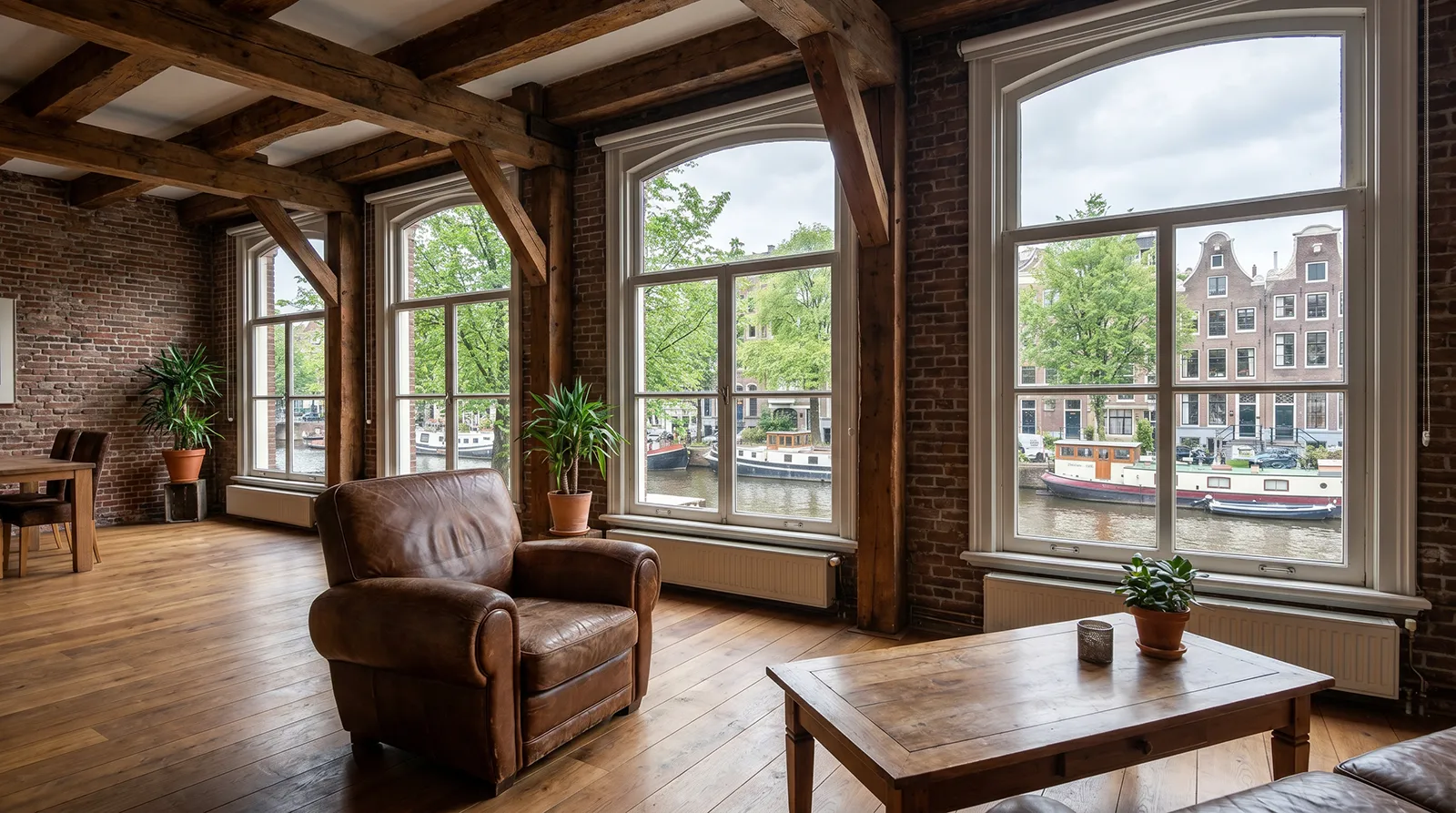
There’s a moment every Amsterdam canal house owner recognises. You climb the steep, narrow stairs to the top floor, duck under a beam positioned for someone considerably shorter, and reach the attic. The space is there – raw, dusty, full of potential. Light filters through a small window or a few roof tiles. You can see the timber frame, centuries old, still doing its job.
And you think: this could be a bedroom. An office. A bathroom, even.
Then you start asking questions.
The Allure – and the Reality
Amsterdam’s grachtenpanden – the canal houses lining the city’s UNESCO-listed waterways – were built mostly during the Dutch Golden Age. They were designed as combined living and working spaces for merchants, with goods stored in the upper floors and attic, hoisted by the beam and hook that still protrude from many facades.
That history is part of their charm. It’s also the source of nearly every challenge you’ll face when converting a canal house loft into modern living space.
The houses are narrow, typically 5–8 metres wide. They’re deep, often 10–15 metres or more. And they’re tall, stacked four or five storeys high, with staircases that get steeper as you ascend. The zolder was storage space, not living space.
Converting it into something comfortable, legal, and structurally sound – while respecting the heritage status that protects these buildings – is one of the most specialised renovation challenges in the Netherlands.
People do it, though. In a city where space is scarce and canal district property routinely trades at €8,000–€15,000 per square metre, an extra 20–30 m² of living area can add well over €200,000 to a property’s value – and transform how you use the building.
The Heritage Question: What Can You Actually Do?
Start here, because it shapes everything else.
Most canal houses in Amsterdam’s historic centre are designated as rijksmonumenten (national monuments) or gemeentelijke monumenten (municipal monuments). Any significant alteration requires permission from the relevant heritage authority – typically the Commissie Ruimtelijke Kwaliteit and, for rijksmonumenten, the Rijksdienst voor het Cultureel Erfgoed (RCE).
The rules are strict, and they’re meant to be. These buildings have survived 350 years or more.
In practical terms:
The exterior is almost untouchable. Front dormers are not permitted on canal house facades. The roofline, the facade, the proportions are considered part of the historic streetscape. Rear dormers are sometimes possible, depending on the building and its visibility from public spaces, but even these require negotiation.
Roof windows (dakramen) are often permissible, with conditions. They typically need to be flush-mounted, limited in size, and positioned so they’re not visible from the street. Heritage authorities may have requirements about frame materials and proportions.
The roof structure is usually protected. The original timber frame – the kapconstructie – is often a heritage element in its own right. Structural modifications need to be carefully justified and, in many cases, designed to be reversible.
Interior changes are generally more flexible, but not unregulated. If the building has original plasterwork, historic staircases, or decorative elements, these may also be protected.
The permit process for a monument renovation (omgevingsvergunning for a monument) requires detailed architectural drawings, a heritage impact assessment, and sometimes a structural engineering report. Processing times can run to several months, and the committee may request modifications before granting approval.
This is not a process to rush – and not a process to skip. Unpermitted work on a monument can result in enforcement action, fines, and an order to reverse the changes at your expense. The municipality of Amsterdam has become increasingly active on this.
The most useful thing you can do before anything else: engage an architect who specialises in monument renovations. Not an architect who once did a loft conversion in Haarlem. An architect who knows the Amsterdam heritage committee, understands what they will and won’t accept, and can design a scheme that works within the constraints. That single decision saves more time and money than anything else.
The Staircase Problem
Ask any contractor who works on canal house lofts what the biggest challenge is, and they’ll say: the stairs.
Dutch canal house staircases approach 70 degrees in the upper floors. They’re narrow, sometimes barely 60 centimetres wide. And they were built before building codes existed, for people who were, on average, considerably smaller.
For a loft conversion to be legally classified as living space (verblijfsruimte) under Dutch building regulations (the Besluit bouwwerken leefomgeving under the Omgevingswet), the staircase serving it needs to meet minimum requirements: minimum width, maximum steepness, adequate headroom, and an escape route in case of fire.
Meeting these requirements in a canal house is a spatial puzzle.
The most common solutions include:
Alternating tread stairs (vlindertrap or paddle stairs). These designs use asymmetric treads that alternate left and right, allowing a steeper stair to remain walkable while taking up less horizontal space. They’re widely used in Dutch loft conversions and are generally accepted under building regulations, though they’re not always comfortable for daily use – especially if you’re carrying laundry or a child.
Spiral staircases (wenteltrap). Compact and visually striking, spiral stairs can work well in tight spaces. They need to meet minimum diameter requirements to qualify as a primary access route, and moving furniture up them is essentially impossible. (Then again, that’s what the hook and beam on the facade are for.)
Reconfigured straight stairs. In some cases, it’s possible to redesign the staircase layout to create a less steep, wider stair by borrowing space from an adjacent room or repositioning the stair opening. This is often the best solution for comfort and safety, but it requires sacrificing floor area on the level below – which, in a narrow canal house, is a significant trade-off.
Ship’s ladders and retractable stairs generally do not meet building code requirements for a permanent living space. They may be acceptable for an attic used as occasional storage or a hobby room, but not for a bedroom or office counted as formal living area.
The fire safety aspect warrants its own mention. If your loft creates a sleeping space, Dutch regulations require adequate escape routes. In a multi-storey canal house with a single steep staircase, this often means fire-resistant doors, smoke detection, and sometimes an escape window or external route. The Amsterdam fire service (Brandweer Amsterdam-Amstelland) can advise on requirements for your situation, and their input is sometimes required as part of the permit process.
Structural Realities: What’s Holding Everything Up?
Canal houses are timber-framed, built on wooden pile foundations driven into Amsterdam’s soft, waterlogged soil. They lean, they settle, they shift. The characteristic forward tilt of many facades was intentional – it made hoisting goods easier – but centuries of settlement have often added to the lean.
When you’re converting a loft, you need to know what the existing structure can carry. The answer is often: not much more than it already does.
A structural engineer (constructeur) is essential. They’ll assess:
- The load-bearing capacity of the existing floor joists (balklaag) between the top floor and the attic. Can they support living-space loads? Reinforcement is often needed – additional steel beams, sistered joists, or a new floor structure.
- The roof frame’s condition and capacity. Centuries-old timber can be in excellent condition – or riddled with rot, beetle damage, or previous repairs. A thorough inspection is necessary.
- The impact on the overall structure. Canal houses are interconnected systems. Changed loads at the top of the building can affect walls, foundations, and neighbouring properties.
- Foundation capacity. Amsterdam’s wooden pile foundations have a finite bearing capacity. Adding significant weight to the top of a building can cause settlement in severe cases. For major conversions, a foundation assessment may be required.
Lightweight construction techniques have advanced considerably. Timber-frame partition walls, lightweight screed floors, and modern insulation can create comfortable living spaces without dramatically increasing structural loads. Steel reinforcement, where needed, can often be integrated discreetly.
Insulation, Climate, and Comfort
An uninsulated canal house roof is thermally a disaster. In summer, the attic becomes an oven. In winter, it’s freezing. Without proper insulation, no amount of heating or cooling will make the space comfortable or affordable to run.
Insulating from the inside (binnenisolatie) is the standard approach, since altering the exterior roof surface is usually restricted by heritage rules. This means fitting rigid insulation boards or spray foam between and beneath the rafters, covered with a vapour barrier and finished with plasterboard or timber cladding.
The challenge is headroom. Every centimetre of insulation added to the inside of the roof reduces the already limited height. In an attic where standing height is marginal, losing 10–15 centimetres to insulation can make the difference between a usable space and one you can only use while crouching.
High-performance thin insulation – vacuum insulation panels (VIPs), aerogel-based boards, PIR/PUR foam – can reduce this trade-off, at a premium cost. Discuss the options with your architect and installer to find the right balance between thermal performance, available space, and budget.
Ventilation is equally critical. A well-insulated, airtight loft needs mechanical ventilation to prevent moisture buildup, condensation, and mould. This matters particularly in a canal house, where the lower floors often have natural ventilation through old windows and gaps that the sealed attic won’t have.
A balanced mechanical ventilation system with heat recovery (WTW – warmteterugwinning) is the best solution. Routing the ductwork through a canal house without disturbing historic fabric requires planning.
The Practical Realities of Construction
Renovation in an Amsterdam canal house means logistics are half the battle.
The streets are narrow. Parking is impossible. The houses have no gardens, no driveways, no space to store materials. Everything – every sheet of plasterboard, every steel beam, every bag of cement – comes through the front door, up those steep stairs, or through the windows via the facade hook.
For loft conversions, this means:
- Materials need to be sized accordingly. Large prefabricated elements that would be straightforward in a suburban renovation may not fit through the access points of a canal house. Custom-cut, on-site assembly is often the only option.
- Crane access is limited but sometimes possible. For heavy items like steel beams or bathtubs, a small crane (hijskraan) positioned on the canal or street can hoist materials directly through the roof or a large window opening. This requires a permit from the municipality and coordination with canal boat traffic. It adds cost, but it’s sometimes the only practical option.
- Noise and working hours are regulated. Amsterdam’s inner city has strict rules about construction noise, particularly in residential areas. Expect limitations on working hours and requirements to notify neighbours.
- Contractor access is a daily challenge. Your builder’s van can’t park outside. Their workers need to haul tools up four flights of steep stairs every morning. This affects productivity, timelines, and the willingness of contractors to take on the work in the first place.
Finding a contractor experienced in canal house renovations is essential and not always easy. The best ones are in high demand. Start looking well before you need them, and expect lead times of several months.
Budgeting: What to Expect
Costs vary considerably depending on scope, building condition, and specification. Rather than a single figure, it helps to understand what drives the budget.
The main cost factors:
- Structural work – reinforcing floors, modifying or supplementing the roof frame, adding steel beams. The more structural intervention needed, the higher the cost.
- Staircase modifications – adapting or replacing the existing stair is rarely cheap in a tight, historic building.
- Insulation and climate systems – high-performance insulation, mechanical ventilation, and heating or cooling all add up.
- Bathroom installation – plumbing, waterproofing, and drainage running down through the building are significant cost items.
- Finishes and joinery – the range is wide, from basic plasterboard to custom-built furniture following the roof angles.
- Professional fees – architect, structural engineer, heritage consultant, and permit costs typically add 10–15% on top of construction costs.
- Logistics – crane hire, restricted access, and the general inefficiency of working in a constrained historic building inflate costs compared to a standard renovation.
Get detailed quotes from multiple contractors experienced in monument renovations, and build in a contingency of at least 10–15% – in a 350-year-old building, there will be unexpected discoveries.
The VAT advantage for monuments: Renovations to rijksmonumenten qualify for a reduced VAT rate on labour costs, against the standard 21%. On a labour-intensive project like a loft conversion, this is a meaningful saving. Have your contractor invoice labour and materials separately to use it.
Rijksmonument owners may also be eligible for subsidies and low-interest loans through the Nationaal Restauratiefonds. Whether a loft conversion qualifies depends on the work – pure modernisation typically doesn’t, but restoration of historic roof structures or other heritage elements may. Worth exploring before you finalise your budget.
Creative Solutions That Actually Work
The constraints of canal house renovation have pushed architects toward some practical and precise design solutions. A few approaches that specialists have refined over the years:
The “box within a frame” approach. Rather than modifying the historic roof structure, some architects design a freestanding interior structure within the existing frame – essentially building a new room inside the old attic. This preserves the original timber frame while creating a well-insulated, properly finished living space. The original beams remain visible, which looks good and keeps heritage authorities satisfied.
Lowering the top floor ceiling. Gaining headroom in the attic is sometimes achieved not by raising the roof (usually impossible under heritage rules) but by lowering the floor – which means lowering the ceiling of the room below. This requires careful structural assessment and reduces the height of the floor below, but in houses with generous ceiling heights on the lower floors, it can be a viable trade-off.
Maximising light without dormers. Since front dormers are almost always prohibited and rear dormers are difficult, architects have become creative with roof windows, light tubes (lichtkokers), and internal light wells. Strategically placed mirrors and light-coloured finishes amplify whatever light is available. Some designs incorporate a glass floor section that allows light to filter between levels.
Wet rooms instead of traditional bathrooms. A compact wet room – where the entire room is waterproofed and the shower area shares space with the toilet and basin – can deliver full bathroom functionality in as little as 3–4 square metres. Common in canal house conversions, and when well designed, it doesn’t feel cramped.
Built-in furniture. In a space where every centimetre counts, freestanding furniture is often impractical. Built-in beds, desks, wardrobes, and shelving that follow the roof angles make far better use of the available volume. Think of it as yacht design applied to architecture – precision and efficiency over volume.
The Permit Process Under the Omgevingswet
Since January 2024, the Netherlands has operated under the new Omgevingswet (Environment and Planning Act), which replaced a raft of older legislation including the Wet algemene bepalingen omgevingsrecht (Wabo). For canal house renovations, permits are now handled through the national Omgevingsloket digital portal.
In theory, the Omgevingswet streamlines the process by integrating building permits, heritage permits, and environmental considerations into a single application. In practice, the transition has been uneven – the digital system has faced criticism for complexity and technical issues, and processing times have in some cases lengthened during the transition period.
For a monument loft conversion, you’ll typically need:
- An omgevingsvergunning for building work (bouwactiviteit)
- An omgevingsvergunning for modification of a monument (rijksmonumentenactiviteit or omgevingsplanactiviteit for municipal monuments)
These can be submitted as a single application but are assessed by different bodies. The heritage component is assessed by the municipal heritage committee with input from the RCE (for rijksmonumenten), while the building component is assessed against the technical building regulations.
A tip from experienced practitioners: engage in pre-application consultation (vooroverleg) with the municipality before submitting your formal application. This lets you present your plans to the heritage committee and get feedback before committing to a full application. It can save months of back-and-forth and significantly increase the chances of approval on the first attempt.
Is It Worth It?
For most owners, yes.
Canal district property trades at €8,000–€15,000+ per square metre. A loft conversion adding 25 m² of living space can add €200,000 or more to a property’s value, against a total project cost – including professional fees and contingency – of perhaps €100,000–€150,000 for a well-specified conversion. The financial return is substantial even after accounting for heritage negotiations and logistical difficulty. An architect or estate agent familiar with the canal district can give you a more precise estimate for your specific building.
Beyond the numbers: a converted canal house attic – with exposed beams, rooftop views, the quiet of being above the city – is a different kind of room from the ones below. The space was built when Rembrandt was working, when VOC ships were leaving the harbour. Making it work for 21st-century life, without destroying what makes it worth keeping, is the harder part of the job. It’s also the part that shows.
For guidance on heritage renovation permits in Amsterdam, contact the municipality’s monument advisory service or visit amsterdam.nl. The Nationaal Restauratiefonds (restauratiefonds.nl) provides information on financing options for monument owners. For finding architects and contractors experienced in canal house renovations, the Bond van Nederlandse Architecten (BNA) and the Vakgroep Restauratie maintain directories of specialists.
Disclaimer. This article is intended as a general overview of the challenges and considerations involved in canal house loft conversions in Amsterdam. It is not a substitute for professional architectural, structural, or legal advice. Heritage regulations, building codes, permit requirements, and tax rules can and do change, and the specifics of every canal house are different. The information described here is based on what was available as of May 2026 and should be verified with the relevant authorities and qualified professionals before any decisions are made. We cannot accept responsibility for any actions taken or costs incurred based on the information in this article. Always consult a specialist architect, structural engineer, and the local municipality before embarking on a canal house renovation project.