
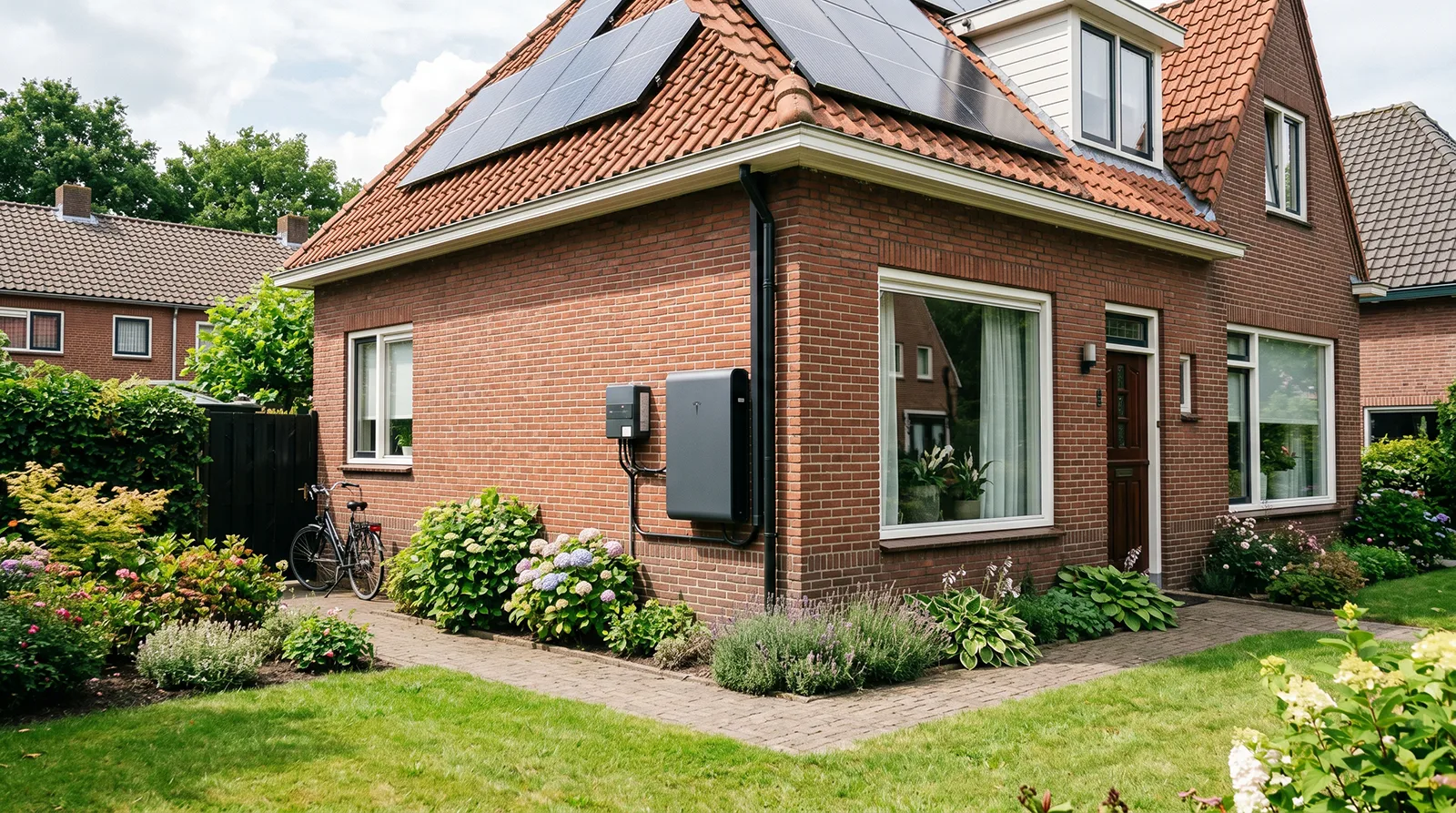
The Dutch net-metering scheme is on its way out. For hundreds of thousands of solar panel owners, that changes the maths. Does investing in a home battery finally make sense, or is it still too early?
For years, Dutch homeowners with solar panels had it remarkably good. The net-metering scheme (salderingsregeling) meant that every kilowatt-hour fed back into the grid was worth exactly as much as every kilowatt-hour consumed from it. Your meter ran backwards when the sun was shining. It was simple, generous, and it made the economics of solar panels very attractive.
That’s changing.
The Eerste Kamer passed the Wet beëindiging salderingsregeling on 17 December 2024: the scheme ends in one step on 1 January 2027, with no taper. From 1 January 2027 to 1 January 2030 suppliers must pay at least 50 percent of the bare delivery tariff as a feed-in rate. (updated 9 September 2026) No reduction has begun: net metering stays fully in place through all of 2025 and 2026, and stops in one step on 1 January 2027. (updated 9 September 2026) By 2027, net-metering is gone entirely.
For the roughly 2.5 million Dutch households with solar panels, this raises an obvious question: what happens to the surplus electricity generated during the day when no one is home to use it?
Which leads to another: should you buy a home battery?
The Core Problem
Solar panels generate most of their electricity in the middle of the day, when the sun is highest. Most households use the bulk of their electricity in the morning and evening: cooking, heating, charging devices, running the washing machine after work.
Under net-metering, this mismatch didn’t matter. You exported your surplus at midday, imported what you needed at 7pm, and the grid worked as a free, effectively unlimited battery. The numbers balanced out on your annual bill.
Without net-metering, that surplus electricity will be compensated at a much lower rate, the so-called terugleververgoeding (feed-in tariff), which energy suppliers must offer but which is significantly less than the retail price you pay for consumption. As of early 2026, typical feed-in tariffs sit around €0.05 to €0.09 per kWh, while retail electricity prices for consumers range between €0.25 and €0.35 per kWh, depending on your contract and supplier.
That gap, roughly €0.20 per kilowatt-hour, is money lost every time you export solar power you could have used yourself.
A home battery closes that gap. Store your midday surplus, use it in the evening, avoid buying expensive grid electricity.
What Does a Home Battery Cost?
A typical home battery system for a Dutch household in 2026 runs from about 5 kWh to 15 kWh of usable storage capacity. The most common setups are around 10 kWh, enough to cover an average household’s evening and nighttime consumption on a decent solar day.
Installed costs by capacity:
- 5 kWh system: €3,500 – €5,500
- 10 kWh system: €6,000 – €9,500
- 15 kWh system: €9,000 – €13,000
These prices include installation, which is not trivial. A home battery needs to be properly integrated with your existing solar inverter (or paired with a hybrid inverter), connected to your meter cupboard, and in most cases mounted on a wall in your garage or utility room.
The market has become more competitive over the past two years. Chinese manufacturers like BYD and Huawei have driven prices down, and European brands like Sonnen are also available. Tesla’s Powerwall remains well-known, though availability in the Netherlands has been inconsistent.
The upfront investment for most households runs between €6,000 and €10,000.
The Payback Calculation
Assumptions for a typical Dutch household:
- Solar panel system: 10 panels, roughly 4.5 kWp
- Annual solar generation: approximately 4,000 kWh
- Self-consumption without battery: around 30% (1,200 kWh used directly)
- Surplus exported without battery: around 70% (2,800 kWh)
- Self-consumption with a 10 kWh battery: around 70–80% (roughly 3,000 kWh)
- Additional self-consumption gained by battery: roughly 1,800 kWh per year
The value of that extra self-consumption:
Avoiding grid electricity at €0.30/kWh instead of receiving €0.07/kWh for exported power gives a net benefit of about €0.23 per kWh shifted.
1,800 kWh × €0.23 = roughly €414 per year in savings.
Payback period for a €7,500 battery system:
€7,500 ÷ €414 = approximately 18 years.
That’s the problem.
Most home battery manufacturers warrant their products for 10 to 15 years, with guaranteed capacity retention of around 70–80% over that period. Lithium iron phosphate (LFP) batteries, now the standard for home storage, are long-lasting, but an 18-year payback on a component warranted for 10–15 years is not a comfortable margin.
Factors That Move the Calculation
Things that shorten the payback:
- Higher electricity prices. If retail prices rise over the coming decade, driven by grid investment costs and carbon pricing, the value of each self-consumed kWh increases. At €0.40/kWh retail, the same calculation yields a payback closer to 13–14 years.
- Dynamic energy contracts. A growing number of Dutch households are on dynamic tariff contracts (dynamisch energiecontract), where electricity prices change hourly based on wholesale market rates. With a smart battery, you can charge during cheap or negative-price hours (wholesale prices in the Netherlands occasionally go negative during sunny, windy afternoons) and discharge during peak hours. This can add €100–€250 per year on top of the solar self-consumption benefit, depending on price volatility.
- Falling battery prices. Battery costs have dropped roughly 30–40% over the past three years, and further declines are expected as manufacturing scales up. Waiting a year or two might get you more capacity for less money.
- Higher self-consumption households. If you have an electric vehicle, a heat pump, or simply use more electricity than average, a battery can shift more value. EV owners benefit especially when charging at home in the evening.
Things that lengthen the payback:
- Lower electricity prices. If wholesale energy prices stabilise at lower levels, the savings per kWh shrink.
- Smaller solar systems. With 6 or 8 panels, there’s less surplus to store, and the battery sits partially empty much of the year.
- Poor system sizing. An oversized battery for a small solar system wastes capacity. An undersized battery for a large system still exports too much. Getting the match right matters.
- Installation complications. Older homes, unusual meter setups, or the need for a new hybrid inverter can push installation costs above the averages above.
What About Subsidies?
As of 2026, there is no dedicated national subsidy for home batteries in the Netherlands. The ISDE subsidy, which covers heat pumps and insulation, does not extend to battery storage. There have been discussions and motions in the Tweede Kamer, but nothing has become policy.
Some municipalities and provinces offer local grants or incentives, but these are patchy and often modest. Check with your local gemeente, but don’t count on it as a significant factor in your financial planning.
The VAT situation is more favourable. Since 2023, the 0% VAT rate that applies to solar panels has been extended to battery systems installed alongside or in connection with solar panels, saving you 21% on the purchase price. This is already reflected in most of the installed prices quoted above.
There has been ongoing debate about whether the 0% VAT on solar and batteries will continue beyond 2027. Dutch policy could shift, but for now it remains in place.
Other Reasons People Buy Batteries
Not everything comes down to payback period.
Energy independence is a real motivation for many homeowners. The 2022 energy crisis, when gas and electricity prices spiked sharply, left a lasting impression on Dutch households. Being less exposed to volatile markets and more in control of your own energy supply has genuine value, even if it doesn’t appear in a spreadsheet.
Backup power is another consideration, with an important caveat. Not all home battery systems provide backup during a grid outage. Many standard installations are grid-tied and will shut down when the grid goes down, for safety reasons. If backup power matters to you, you need a system specifically designed for it, which typically costs more. The Netherlands has a very reliable grid, so outages are rare.
Future compatibility may be the most practical non-financial argument. The energy system is changing. Vehicle-to-grid technology, smart home energy management, and neighbourhood-level energy sharing are all developments that a home battery positions you for. Whether that translates into tangible value in the next five years is uncertain, but the direction is clear.
What Makes Financial Sense
Energy advisors in the Netherlands broadly agree on the conditions where a home battery makes sense financially:
A home battery is likely to pay off if you:
- Have a relatively large solar panel system (8+ panels, ideally 12+)
- Are on or willing to switch to a dynamic energy contract
- Have high electricity consumption, especially in the evening (heat pump, EV, large household)
- Plan to stay in your home for at least 10–15 years
- Value energy independence beyond pure financial return
A home battery is harder to justify on economics alone if you:
- Have a small solar system
- Have low overall electricity consumption
- Are on a fixed-rate contract with a reasonable feed-in tariff
- Are primarily motivated by short-term payback
- Are in a home you might sell within a few years
It’s also worth noting that installing a battery doesn’t have to be all-or-nothing. Some homeowners start with a smaller system (5 kWh) and expand later as prices drop or their needs change. Modular systems that allow this exist, though they’re not yet the norm.
The Market Is Moving Fast
Battery technology is improving, prices are falling, and the software managing home energy systems is getting smarter. Systems that automatically optimise charging and discharging based on dynamic tariffs, weather forecasts, and household consumption patterns are already available.
The Dutch energy market is also changing. Grid congestion (netcongestie) is a growing problem, with the electricity grid in many regions struggling to handle the volume of solar power fed back during peak production hours. Home batteries that reduce grid export could, in the future, be rewarded through grid services or congestion payments. Some pilot programmes are already underway.
The value case for a home battery in 2028 or 2030 may look quite different from today. The question is whether you invest now and grow into that value, or wait and potentially get a better deal later.
So, Is It Worth It?
For most Dutch households in 2026, a home battery is not yet a clear financial win. The maths is improving, but payback periods still exceed warranty periods in typical scenarios.
If you already have solar panels and either a heat pump or an electric vehicle, the numbers are more favourable. Dynamic tariff contracts improve them further. And if energy independence matters to you beyond the spreadsheet, those considerations belong in the calculation too.
The next two to three years may be the practical window: battery prices will likely continue falling, the full effect of the end of net metering will become tangible, and dynamic tariffs will become more mainstream.
If you’re seriously considering it now: get multiple quotes, insist on LFP chemistry (safer and longer-lasting), confirm your installer is certified, and run the numbers for your specific system and consumption, not a generic scenario from a manufacturer’s brochure.
For independent advice on home energy storage, the Dutch consumer organisation Milieu Centraal (milieucentraal.nl) offers regularly updated guidance. Your local energy cooperative or municipal energy advisor can also assess whether a battery makes sense for your situation.
Disclaimer. This article is a general overview of home battery storage in the context of the Dutch energy market and the end of net metering. It is not personalised financial advice. Prices, subsidy conditions, energy tariffs, and government policies can change. The calculations here are illustrative and based on typical scenarios; your actual savings will depend on your specific solar system, energy consumption, contract terms, and local circumstances. Always verify current pricing, product specifications, and policy details through official sources such as rvo.nl and milieucentraal.nl, and consider consulting a qualified energy advisor before making any investment decision. We cannot be held responsible for decisions made based on this article.