
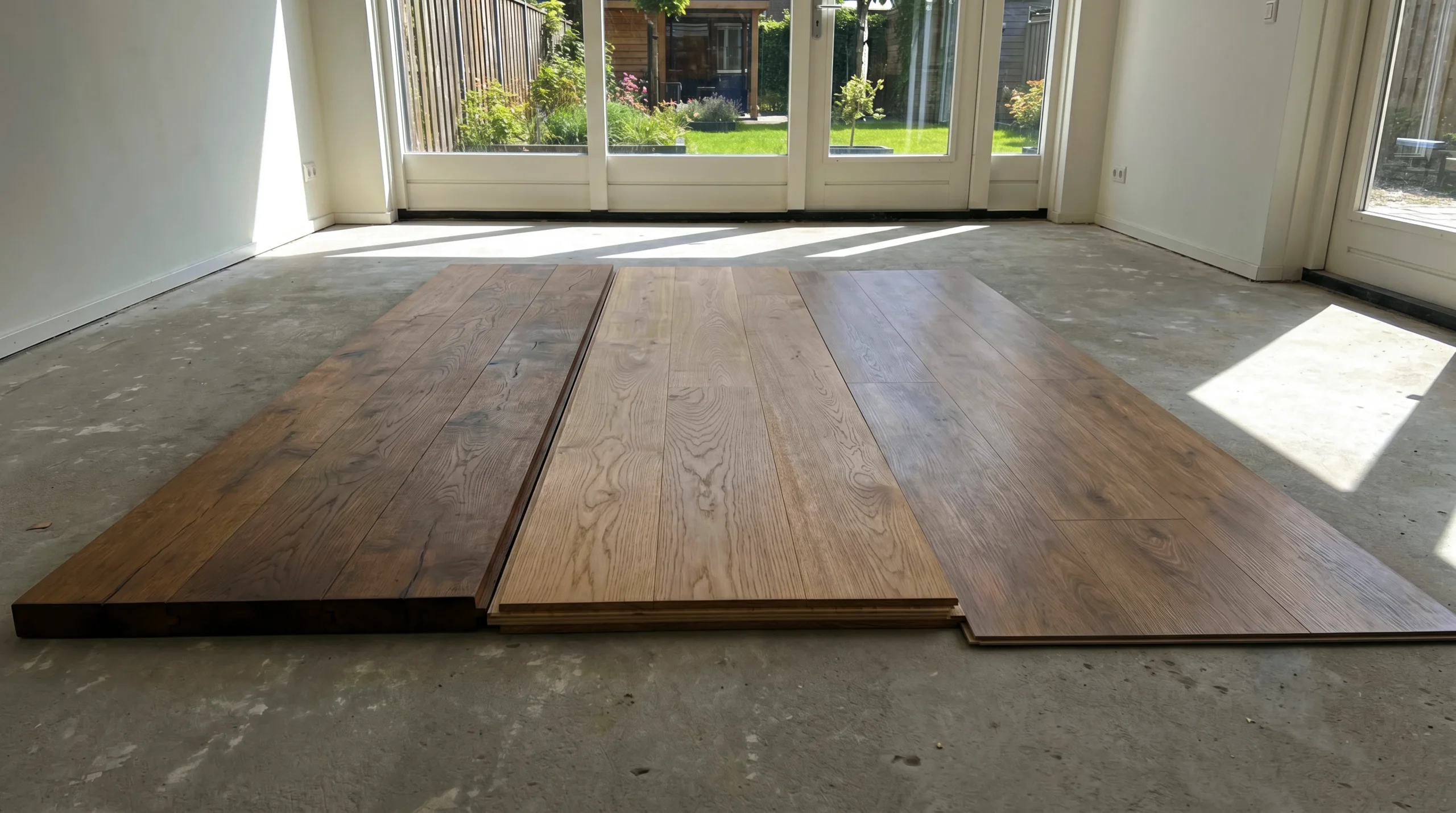
Most Dutch homeowners who want a wooden floor choose between three options: solid wood, engineered wood and laminate. They look similar once laid, but they behave differently in a Dutch home. Damp winters, crawl-space moisture under ground floors, VvE rules on contact noise in apartments and underfloor heating all change which floor fits. Four things usually decide it: moisture resistance, underfloor heating compatibility, price per m² and how long the floor lasts.
Why the choice is different in Dutch homes
Dutch conditions are hard on floors. Winters are damp, ground floors can take up moisture from the crawl space, and many apartments carry VvE rules on contact noise. A lot of renovated homes now run on underfloor heating, which changes what the floor has to do.
So the right floor is not the most attractive one. It is the one that suits the building, the subfloor, the heating system and how the room is used. A busy family kitchen, a quiet bedroom, a floor above neighbours and a ground-floor living room each ask for something different. A floor over underfloor heating needs low thermal resistance and careful installation.
Solid wood
Solid wood is the traditional choice. Each plank is one piece of timber, usually oak in Dutch homes, though other species are available. It has depth, warmth and natural variation.
Its main strength is longevity. A good solid wood floor can be sanded and refinished several times, so scratches, dull patches and colour changes are not always a reason to replace it. Professional sanding and finishing can renew it.
It is also the most sensitive of the three. Wood expands and contracts as humidity and temperature change, and Dutch indoor moisture shifts across the year. Gaps, cupping or warping usually mean the floor, subfloor or indoor climate was not prepared properly.
Solid wood is the hardest partner for underfloor heating. Milieu Centraal’s guidance “Vloeren en vloerbedekking” notes that a solid wood floor passes heat through less well, so it combines less easily with underfloor heating than other wooden floors. Some systems work with carefully selected wood, a suitable plank thickness and professional installation, but wide boards, unstable humidity and high floor temperatures cause problems.
On price, solid wood is usually the premium option. The material is only part of it: subfloor preparation, the glue or fixing method, sanding, finishing, skirting boards and labour push the total up, and premium grades, wide planks and patterns such as herringbone cost more. Check current supplier and installer quotes rather than a general online range.
Solid wood suits homeowners who value authenticity, accept maintenance and want a floor that ages with the house.
Engineered wood
Engineered wood, often called lamelparket, has a real wood top layer over a stable base of plywood or layered timber. The surface is real wood, so it can look almost identical to solid wood.
Its advantage is stability. The layered build reacts less to moisture and temperature than solid wood, which makes it a good fit for many Dutch homes, especially with underfloor heating.
Not every engineered floor suits every heating system. The product has to be approved for underfloor heating, the total thermal resistance has to be low enough, and the installation method has to be right. Glued installation often performs better than a floating system because it improves heat transfer and reduces movement, and the subfloor needs to be dry, level and stable.
Moisture resistance beats solid wood, but engineered wood is not waterproof. Keep it out of bathrooms unless the product and finish are made for that, clean spills promptly in kitchens and hallways, and ventilate.
Longevity depends on the top layer. A thin veneer allows little or no sanding; a thicker top layer can be professionally renovated once or more. The question to ask before buying is not only whether it is wood, but how much real wood there is to work with later.
On price, engineered wood usually sits between solid wood and laminate, though high-end engineered floors reach solid wood prices. Material, pattern, top-layer thickness, finish and installation method all move the cost per m².
Engineered wood is often the best compromise for homeowners who want a real wood surface with better stability and underfloor heating compatibility.
Laminate
Laminate is not wood. It is usually a high-density fibreboard core with a printed wood-look layer and a protective coating. Good laminate can look convincing and is a long way from the thin, glossy boards sold years ago.
Its main draw is price. The Werkspot 2026 guide “Kosten laminaat leggen in 2026” puts laying labour at roughly €9 to €15 per m², and a full laminate floor including material, underlay and skirting usually runs about €25 to €55 per m². Treat both as indicative and get quotes for your room.
Laminate is also practical: easy to clean, reasonably scratch-resistant, and available in many colours, sizes and patterns. For family homes, rentals, spare rooms and tighter budgets it makes sense.
The limits are clear too. Laminate cannot be sanded or refinished, so a damaged plank is replaced rather than repaired. Standard laminate is moisture-sensitive, because the core can swell if water reaches the joints. Water-resistant laminate is improving, but read the specification: “water-resistant” does not always mean suitable for wet rooms.
Laminate works with underfloor heating only when the board and underlay are suitable. The wrong underlay acts as insulation and stops heat reaching the room, which matters in Dutch homes where underfloor heating is the main heat source.
In apartments, contact noise is the other issue. The VvE Belang article “Geluidsoverlast door harde vloeren binnen de VvE” explains that many associations only allow hard flooring that improves the contact-noise isolation index (Ico) by 10 dB or more over a bare concrete floor, a norm set by the Nederlandse Stichting Geluidshinder. That depends on the whole build-up, not the board alone: laminate, underlay, subfloor and installation. Keep the floor clear of the walls at the edges so sound is not carried into the structure.
Moisture resistance
None of the three matches tile or PVC for water resistance, but they differ. Solid wood is the most sensitive and needs a stable indoor climate and a dry subfloor. Engineered wood is more stable and better suited to changing Dutch conditions, though it still needs protection from standing water. Laminate varies: standard boards are weak at the seams, while water-resistant versions hold up better in kitchens and hallways without being fully waterproof. For basements, bathrooms and poorly ventilated ground floors, be cautious with all three and get professional advice first.
Underfloor heating
Underfloor heating changed the flooring market in the Netherlands, because the floor is now part of the heating system. The main issue is thermal resistance: a thick or insulating floor slows heat transfer and makes the system less efficient. Engineered wood and laminate both work well when the product is approved and the underlay is right. Solid wood needs more caution and specialist judgement.
Installation matters here. The subfloor has to be dry enough, the heating has to be commissioned gradually, and floor temperature limits have to be respected. Skipping these steps leads to movement, gaps, cracking or weak heating.
Price per m²
Prices change with region, stock and finish, so treat any figure as indicative and check directly with sellers and installers. Laminate is the cheapest of the three, in both material and labour, with the total rising for better wear classes, sound-reducing underlay, moisture-resistant boards, skirting and complex patterns. Engineered wood is mid-range to premium, set mostly by top-layer thickness, wood grade, plank width, finish and installation method. Solid wood is generally the most expensive across a full project once sanding, finishing, glue, subfloor correction and detailed patterns are added.
The lowest material price is not the lowest project price. A cheap floor over a poor subfloor gets expensive once levelling, acoustic underlay, moisture barriers or repairs are added.
Which floor to choose
Choose solid wood for a natural floor with a long life if you accept professional maintenance. Choose engineered wood for the look and feel of real wood with better stability and stronger compatibility with modern Dutch heating systems. Choose laminate if budget, speed and easy maintenance matter most and you accept that the floor is replaced rather than restored at the end of its life.
For many Dutch renovations, engineered wood is the balanced choice. Solid wood can still be worth it in premium or heritage interiors. Laminate works for practical family spaces and apartments, as long as the sound and heating requirements are handled.
Before you decide
Four questions narrow the choice quickly: Is the subfloor suitable? Is there underfloor heating? Does the VvE set a contact-noise norm? And how long do you want the floor to last? Once those are answered, the choice is less about the showroom and more about what fits the building.
LucKey Construction installs solid wood, engineered wood, laminate, parquet, PVC, tile and cork floors; the homeowner chooses the material and the contractor handles installation.
Disclaimer. This article is a general overview of solid wood, engineered wood and laminate flooring in the context of Dutch homes. It is not personalised building or installation advice. Prices, product specifications, underfloor-heating suitability, and VvE rules on contact noise can change, and they vary by region, supplier, building, and subfloor. The figures here are 2026 indicative ranges and are illustrative only; your actual costs and the right floor for your situation will depend on your property, its subfloor, your heating system, and your VvE’s requirements. Always verify current pricing, product specifications, and contact-noise norms through official sources such as milieucentraal.nl and the manufacturer’s documentation, check your own VvE rules, and consider consulting a qualified flooring installer before making any decisions. We cannot be held responsible for decisions made based on this article.