
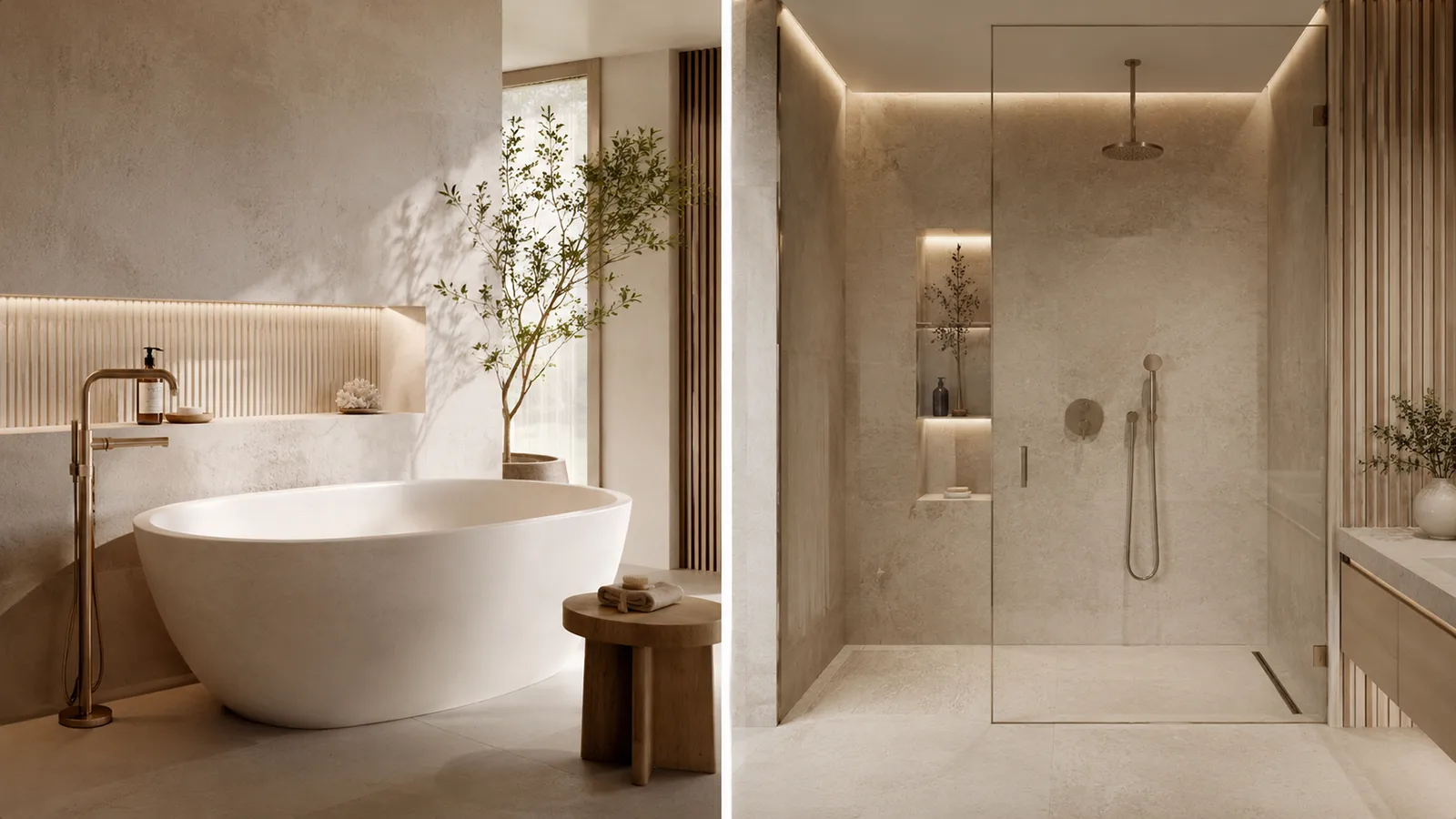
A bathroom shapes how a home feels, and in the Netherlands, where bathrooms are often compact and every square metre has to earn its place, the choice between a walk-in shower and a bathtub is more than a design preference. It touches daily use, resale value, family life, accessibility and space.
In recent years the walk-in shower has become the favourite in many Dutch bathroom renovations. It looks modern, feels spacious, is easier to get into, and fits the wellness-style bathroom that buyers now expect. The bathtub has not disappeared, though. Families still value it, some buyers expect at least one bath in a larger home, and for many people a tub is about comfort rather than washing.
So which adds more value to a Dutch home, the inloopdouche or the bad? It depends on the home.
Why walk-in showers have gained ground
The appeal is easy to see. A walk-in shower saves visual space, works well in smaller bathrooms, and creates the open, calm look many buyers want. A fixed glass panel, a flush floor, large tiles and a clean drain line can make a tight room feel orderly rather than cramped.
Accessibility is part of it too. A low-threshold or threshold-free shower is easier to enter than a bathtub, which matters for older residents, anyone recovering from injury, and people planning to stay in the home for years. That makes it a practical long-term choice, not only a trend.
For resale, walk-in showers read as current. They signal an updated bathroom, they photograph well in listings, and they fit the shift toward bathrooms that feel less purely functional and more like small wellness spaces.
Where a bathtub still adds value
A bathtub offers a different kind of value. It is less efficient, usually takes more space, and may go unused by adults with busy routines. But for families with young children it stays useful in a way a shower cannot fully replace.
This matters in the Dutch resale market. If a home is clearly aimed at families, say a three-bedroom house with a garden or a larger apartment near schools, removing the only bathtub can make the property less convenient for part of the target audience. A bath also carries some emotional weight: some buyers want the option of a long soak even if they rarely take one, and in a larger bathroom a freestanding or built-in bath adds a sense of comfort.
Not every bath adds value, though. Oversized whirlpool baths, dated corner tubs and tubs forced into rooms too small for them can do the opposite, reading as maintenance, water use and wasted space rather than comfort. The bath that adds value is usually simple, well-proportioned and sized to the room.
Small bathrooms
In a small bathroom, the walk-in shower usually wins. Many Dutch bathrooms sit between practical and tight, and in apartments, older terraced homes and city properties a bathtub can dominate the room, leaving too little space for storage, circulation, a decent vanity or comfortable access to the toilet. A walk-in shower uses the footprint better: it opens up the layout, improves movement and allows cleaner lines. In a compact room, buyers often prefer a spacious shower to a cramped bath.
Execution is what makes the difference. A walk-in shower only adds value if it works properly; poor drainage, water crossing the room, cold draughts, slippery tiles or badly placed glass turn a good-looking design into a daily irritation. In a small bathroom a fully open shower is not always best. A fixed glass panel, a carefully planned slope, underfloor heating and good ventilation usually matter more than openness for its own sake.
Family homes
In a family home the answer is more balanced. If there is only one bathroom and the home is likely to attract families, keeping a bathtub or choosing a shower-bath combination is often safer for resale. Parents of young children tend to prefer a bath, dog owners may appreciate one, and even buyers without children can read a missing bath as one fewer option.
That does not mean every family home needs a large bath. If the existing bath is old, impractical or taking up too much room, a modern walk-in shower can still be the stronger choice. What matters is whether the home has another place for a bath, enough bathrooms to split functions, or a target buyer who values accessibility and low maintenance over bathing children.
The best family layout is usually one of three: a main bathroom with both a bath and a separate shower; a compact bathroom with a shower-bath combination; or a walk-in shower in one room and a bath in another. Any of these gives wide appeal, serving daily adult routines while still working for children and guests.
Apartments
For Dutch apartments, especially in cities, the walk-in shower is often the stronger choice. Apartment buyers tend to value efficient layouts, easy cleaning, modern finishes and a sense of space. A bathtub can feel like a luxury when the room is large enough, but if it compromises the washing machine position, storage, ventilation or walkability, it weakens the bathroom rather than improving it.
There is a VvE and technical side as well. Bathroom renovations in apartments can involve rules on drainage, noise, waterproofing and shared structures, and moving a drain to create a walk-in shower may need careful planning. The owner is responsible for checking permissions where they are needed. For resale, a clean, waterproof, well-ventilated bathroom with a generous shower usually appeals to more apartment buyers than a cramped room built around a bath.
Accessibility and ageing in place
The walk-in shower ages better with the occupant. A bathtub asks the body to step over an edge, which becomes harder with age. For older homeowners, a low-threshold shower with grab-bar preparation, anti-slip tiles and enough room to move safely can support independent living for longer.
This does not mean the bathroom has to look medical. The best accessible bathrooms are discreet: good lighting, strong wall backing for future grab bars, comfortable clearances and practical surfaces, without turning the room into a care facility. For a renovation planned around long-term living, a walk-in shower is usually the more future-proof choice.
Water use, maintenance and daily practicality
A shower is not automatically more sustainable than a bath; it depends on length, water flow and habits. According to Milieu Centraal’s “Besparen onder de douche en in bad”, an average shower of about seven to eight minutes uses roughly 55 litres of hot water, while a full bath uses nearly double. A rain shower, at 15 litres a minute or more, can match or beat a bath if you stay under it long enough, and a short shower with a water-saving head uses far less.
For daily maintenance, walk-in showers suit modern routines: quick, practical and easy to pair with water-saving fittings. Large tiles or seamless finishes cut grout lines, provided they are installed correctly. Bathtubs need more cleaning surface, more water per use and more space, but they are easier for bathing children and may suit a household where relaxation is part of the point. The right choice matches actual use rather than an idealised one.
What buyers react to
Most buyers do not assess a bathroom technically at first; they react quickly to whether it looks clean and modern, whether there is enough space and storage, whether the shower is large enough, whether the room feels damp, and whether they would have to renovate straight away. A walk-in shower helps those first impressions land well. A missing bathtub can count against a property that otherwise presents as a family home.
That is the core resale point: do not design the bathroom in isolation, design it for the type of home. A starter apartment, a senior-friendly ground-floor home, a family house and a luxury villa do not need the same bathroom.
When to choose a walk-in shower
A walk-in shower is the better choice when the bathroom is small, the current bath is rarely used, accessibility matters, the home is aimed at starters or older buyers, or the goal is a modern, spacious layout. It also makes sense when the existing bath leaves the room feeling narrow or dated; removing it can free space for a wider vanity, better lighting, niche storage and a more comfortable shower zone. For value, it works best when it is generous, easy to clean and technically sound.
When to keep or add a bathtub
Keep or add a bathtub when the home is family-oriented, has the space, or already has a separate shower. A bath can also suit a larger primary bathroom that can support a calm, spa-like layout. Avoid forcing a bath into a tight space, where it rarely feels like a selling point; if the choice is between a poor bath and an excellent shower, the shower is usually the better investment. One good bath somewhere in the home is useful for resale; one bad bath in the only bathroom is not.
Shower-bath and dual layouts
Sometimes the best answer is neither extreme. A shower-bath combination works when space is limited but family appeal matters; it is not as luxurious as a separate walk-in shower, but it keeps flexibility, which helps in apartments or smaller houses where the buyer may include young families. In larger homes, separate functions are usually strongest: a walk-in shower for daily use and a bathtub for children or relaxation. That gives the widest buyer appeal and keeps the bathroom from feeling locked into one lifestyle.
Planning the renovation
A bathroom renovation is not only about choosing sanitaryware. It involves waterproofing, drainage, ventilation, tiling, heating, lighting and electrical safety. A walk-in shower depends on slope, drain capacity, sealing, glass placement and surface choice; a bathtub depends on structure, plumbing, access panels and proportion. It is worth settling both lifestyle and resale goals before fixing the layout. A contractor can assess whether the room can take a walk-in shower, a bathtub, or both, without compromising safety and comfort.
In the Netherlands a walk-in shower usually adds more modern appeal, particularly in small bathrooms and apartments, where it makes the room feel bigger, supports accessibility and matches what buyers expect. A bathtub still holds value in family homes, and removing the only bath from a house aimed at families can narrow the buyer pool, just as keeping a dated or oversized tub in a small bathroom can. The bathroom that adds the most is the one that fits the home, the household and the likely future buyer: a small room is better off with an excellent shower; a family home with space should keep a bath somewhere; and where there is room for both, that is usually the strongest answer.