
How to Create Climate-Controlled Wine Storage That Actually Works
From a simple climate cabinet to a full wijnkelder, Dutch renovations offer the perfect moment to give your bottles the stable, dark home they need.
Most Dutch houses were never designed with wine in mind. Central heating keeps living rooms at a cosy 20–22°C, kitchens swing between oven heat and dishwasher steam, and large windows let in the very light that slowly dulls a fine bottle. For anyone who has started collecting more than a few cases, the question quickly becomes practical. Where can the wine actually rest?
A renovation is the obvious moment to answer it. Whether you are opening up a basement, reclaiming space under the stairs, or simply planning new kitchen units, the decisions made then determine whether your bottles age gracefully or quietly suffer. The good news is that proper wine storage design in the Netherlands does not require a château. It requires attention to a few unchanging physical facts.
What wine actually needs
Wine is a living liquid. Its chemistry continues after bottling, and the rate of that chemistry is governed by temperature, humidity, light and movement. The consensus among specialists is consistent. A stable temperature between 10 and 14°C, relative humidity of 60–75%, darkness, minimal vibration, and clean air without strong odours.
Temperature matters most. Too warm and the wine ages too fast, sometimes developing cooked or stewed notes. Too cold and the process almost stops. Rapid swings are worse than a steady temperature a degree or two off the ideal. Humidity keeps natural corks from drying and shrinking; if the cork fails, oxygen seeps in and the wine oxidises. Light, especially ultraviolet, drives unwanted reactions. Vibration keeps sediment and molecules in constant mild agitation. None of this is exotic science – it is simply the same care a serious cellar has always provided.
The Dutch starting point
True underground cellars remain rare in the Netherlands, but where they exist they are often naturally close to ideal: cool, dark and relatively stable around 10–14°C. The challenge is usually humidity. Many Dutch basements and crawl spaces (kruipruimtes) sit above 80% relative humidity for long periods. Labels mould, and mould spores are never welcome near wine. A simple hygrometer will tell you the truth within a week.
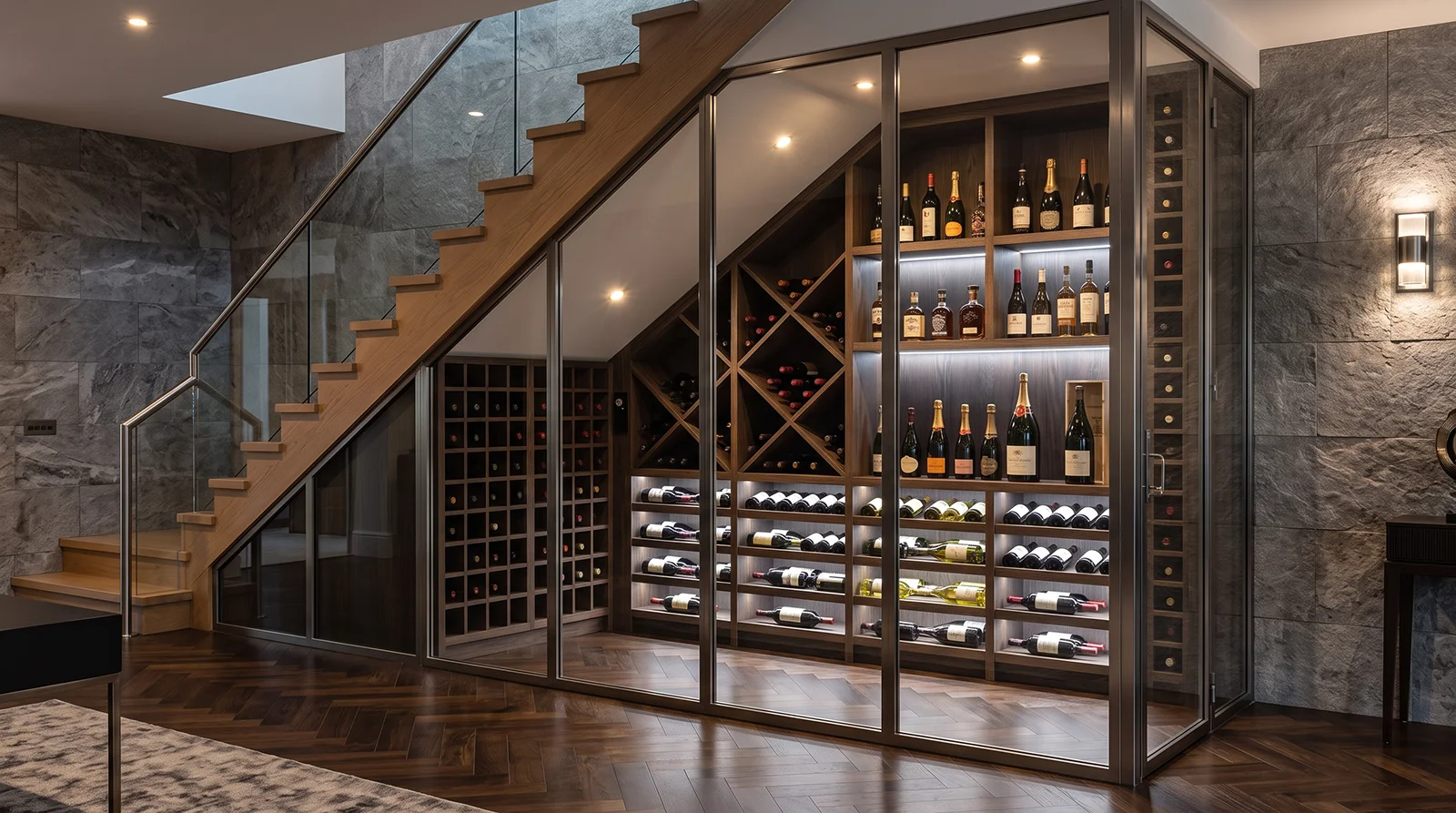
Above ground the picture is different. Living spaces are too warm and too bright. Under-stair cupboards, unused corners of a garage, or a former utility room can work if they are insulated and given active climate control. The renovation itself is the moment to decide which route makes sense for the house and the collection.
Three practical routes during renovation
1. The climate-controlled cabinet
For most households this is the cleanest solution. A purpose-built wine climate cabinet holds temperature and humidity within narrow bands, filters odours, and keeps light and vibration low. Models range from under-counter units that hold 30–50 bottles to tall freestanding cabinets that store several hundred. Dual-zone versions let you keep reds and whites at slightly different temperatures if you want bottles ready for serving as well as long-term rest.
During a kitchen or living-room renovation the cabinet can be integrated so it looks intentional rather than added later. Power and, in some cases, a discreet condensate drain can be planned in advance. The result is climate-controlled wine storage without the cost or complexity of a full room.
2. Converting a basement or crawl space
If the house has a usable basement or a dry enough crawl space, a full wijnkelder becomes possible. The work starts with moisture control. Sealing floors and walls, improving ventilation, and, critically, proper insulation. Closed-cell polyurethane foam is preferred over mineral wool, which can absorb water and lose performance.
Spray foam carries Dutch caveats worth knowing before you agree to it. Rijksoverheid guidance is to use a certified installer, stay out of the house during application and for two hours afterwards, keep the crawl space hatch closed for two weeks, and ventilate the house extra during that period. Foam that is mixed in the wrong ratio does not cure properly, and that is what has produced the health complaints behind the material’s poor reputation. Applied correctly the risk is small. Chosen on price alone it is not.
A dedicated wine-cellar cooling unit, not a standard air-conditioner, then holds the space at the target temperature and manages humidity. That unit needs its own power supply and somewhere to reject its heat, usually an adjacent room or outside air, which is a design decision rather than an afterthought.
Digging out or deepening an existing cellar is a different order of project again. It touches the foundations, needs a structural engineer, and normally requires an omgevingsvergunning, while in an apartment building the VvE has to agree as well. Arranging that permission and notifying the municipality or the VvE is the homeowner’s responsibility, which is why it belongs at the start of the planning rather than halfway through the build.
This route suits collectors with several hundred bottles or more. It also turns an otherwise low-value space into something that adds both pleasure and, in many cases, perceived value to the house. The renovation phase is ideal because structural and service work can be done before finishes go in.
3. A dedicated above-ground wine room
Some renovations create a small room from a former bathroom, pantry or under-used corridor. The same principles apply. Heavy insulation on all six sides, a vapour barrier, a proper cooling system, and minimal glazing or UV-filtered glass if display is desired. Glass doors or a glazed wall can turn the storage into a visual feature without sacrificing conditions, provided the cooling capacity is correctly specified.
Details that decide success
Racking matters less than climate, yet it still shapes daily use. Wooden racks are traditional and gentle on bottles; metal or modular stone systems suit higher humidity. Horizontal storage keeps corks wet. Labelling and a simple inventory system – even a notebook or phone app – prevent the common frustration of knowing you own a bottle but not where it is.
Lighting should be low and warm, ideally LED with minimal UV output, and switched only when needed. Avoid placing the storage next to washing machines, boilers or busy corridors where vibration is constant. And keep strong-smelling materials – paint, cleaning products, new concrete – well away until they have fully cured.
Budget is realistic rather than prohibitive. A small under-counter cabinet starts in the hundreds of euros, while a large dual-zone unit runs into the low thousands. A full basement conversion with cooling and racking costs considerably more, but the work is often combined with other moisture or insulation improvements that the house needs anyway.
A quiet investment in pleasure
Proper wine storage is not about showing off. It is about protecting the slow, quiet process that turns a good bottle into a better one. In a Dutch home renovation the opportunity is a practical one, because the same walls being opened for insulation or services can be prepared for a climate that suits wine as carefully as it suits people.
Whether the final solution is a discreet cabinet in the kitchen, a converted corner under the stairs, or a full climate-controlled wine room, the principles remain the same. Stable temperature, sensible humidity, darkness and calm. Get those right and the bottles will wait patiently, and reward the patience when they are finally opened.
LucKey Construction takes on this kind of work across Zaandam, Amsterdam and the surrounding region, from damp-proofing and insulating a basement to the electrical and finishing work a wine room needs, as part of broader house renovation projects. Which permissions a project is likely to require is flagged at the quotation stage. Submitting them stays with the homeowner.
For anyone planning a wine room renovation, or simply wondering how to set up a wijnkelder in a Dutch house, the renovation itself is the best chance to do it once and do it properly.