
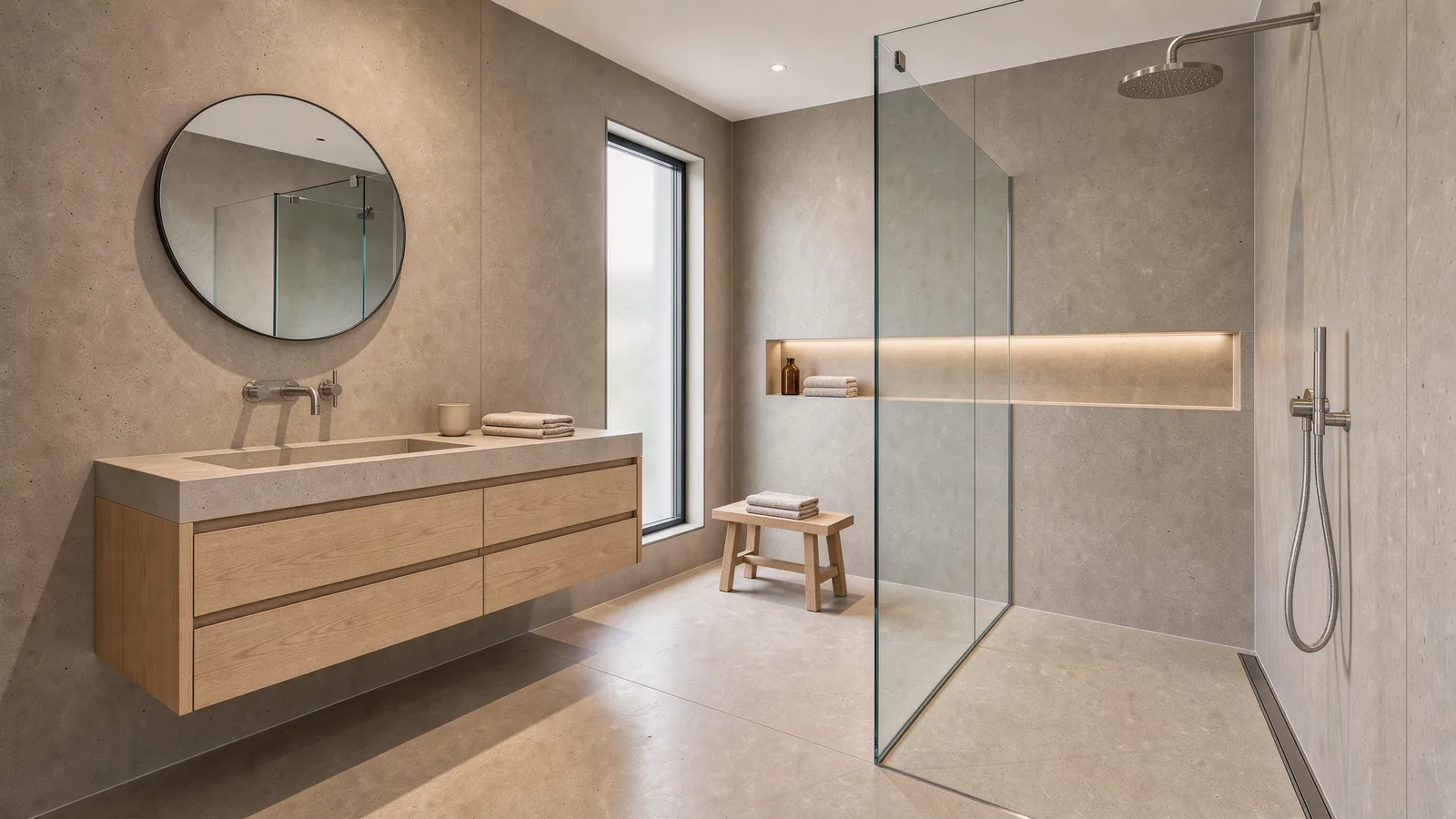
What beton ciré costs per square metre in 2026
Starting prices for walls, floors and bathrooms in four Dutch price guides, how beton ciré compares with microcement, tiles and betonlook paint, what a bathroom needs underneath it, and how to look after it.
Beton ciré starts from €60 per m² on walls and floors in the 2026 Dutch price guides, at Guides A and D of the four compared below, and from €70 at Guide C. Guide B, which quotes with 21 percent VAT included, starts at €100. In a bathroom the starting point rises: Guide D puts wet rooms from €120 per m², and Guide A’s example of 25 m² of bathroom wall starts at €1,750, or €70 per m². Simple tiling starts lower, from €40 per m² with the tiles. Those rates cover the layers and the sealer on a sound, flat surface. Levelling and shower waterproofing are separate lines, and the bathroom worked through below starts at €2,275 for 25 m².
Starting prices in four guides
The four guides, here called A (updated August 2026), B (July 2026), C (January 2026) and D (last updated November 2025, published as its 2026 overview), each give their own figures. Guide B includes labour and 21 percent VAT. Guide A bases its figures on plasterers’ quotes and prices its bathroom example at 9 percent VAT. Guide D says its figures include labour. Guide C does not say what its figures include.
| Surface | Guide A | Guide B | Guide C | Guide D |
|---|---|---|---|---|
| Walls | from €60 | from €100 | from €70 | from €60 |
| Floors | not given separately | from €100 | from €70 | from €60 |
| Bathroom | from €70 (walls) | from €100 | from €650 per room of 5 to 10 m² | from €120 |
The guides do not even agree on which surface costs more. Guide B puts floors higher than walls because they need extra protective layers against wear. Guide C says walls and wet rooms often need more preparation and precision than a floor. Guide C gives one figure for every surface.
Compared with microcement, tiles and betonlook paint
| Finish | From, per m² | Guide |
|---|---|---|
| Betonlook paint (decorative painting) | €40 | Guide C, February 2026 |
| Simple tiling, tiles included | €40 | Guide C, February 2026 |
| Beton ciré, walls | €60 | Guides A and D |
| Microcement, floor | €75 | Guide D, November 2025 |
| Microcement, walls | €80 | Guide D, November 2025 |
| Microcement, bathroom walls and floor | €120 | Guide D, November 2025 |
| Microcement, walk-in shower | €150 | Guide D, November 2025 |
The tile figure leaves out removing the old tiles, from €15 per m² with disposal, and waterproofing with sealing tape in the corners, from €150 per job (Guide C).
Beton ciré, microcement or betonlook: what the words mean in a Dutch quote
In the Dutch market the first two names overlap. Our own service page calls beton ciré “also known as microcement”, and many contractors use both words for one product: a cement-based coating with added resins or polymers, trowelled by hand in thin layers and sealed. Guide D’s microcement page draws a line, with microcement at 2 to 3 mm and flexible enough for tiles and timber, and beton ciré at 3 to 5 mm with a coarser texture. Its own beton ciré page, and Guide B, put beton ciré at 2 to 3 mm. So the name on a quote says little. Ask for the product and manufacturer, the number of layers and the sealer in writing.
Betonlook is a look, not a material: concrete-look paint, betonstuc, or tiles printed to resemble concrete. Betonlook paint is priced as decorative painting over a finished wall, and it does not replace the waterproofing a shower wall needs.
What drives the price: layers, sealer and the surface underneath
Guide C splits a typical beton ciré price into 45 to 55 percent labour, 30 to 40 percent material, 10 to 15 percent preparation and 5 to 10 percent extras. Its line items, all as starting points:
- Primer for adhesion: from €5 per m².
- Material, standard colour: from €30 per m²; special colours and textures from €45.
- Applying several layers: from €30 per m² in labour.
- Levelling the surface: from €10 per m², up to €35 where the corrections are large.
- Sealer: from €8 per m².
- Disposal and cleaning: from €50 per job; extra repairs from €40 an hour.
Guide D lists the build-up as primer, levelling coat, two layers of beton ciré, an impregnating agent and a polyurethane sealer. Each layer dries for 24 to 48 hours and is lightly sanded before the next (Guide B), so a bathroom takes two to four days in Guide B and three to five in Guide D. Guide A counts on 10 to 20 m² a day.
Beton ciré can go over sound existing tiles, which Guide D notes saves demolition and disposal. An uneven or damaged wall first needs sanding or a levelling coat, each from €15 per m² (Guide B).
In a bathroom: the waterproofing goes underneath
The sealer is what makes beton ciré resistant to water. Guide B calls it essential in a bathroom, because without it the finish absorbs water, soap and stains. The sealer protects the surface, though. In a shower, the waterproofing in the layers below it is what keeps water out of the wall and the floor. Guide D prices a microcement walk-in shower higher than any other room, from €150 per m², because it needs the highest level of waterproofing and an exact build-up. Guide C prices a waterproof layer in a shower area from €10 per m², and sealing tape and waterproofing from €150 per job.
Our bathroom renovation cost guide explains why a shower floor needs a fall to the drain and waterproofing under the finish, and why cheap quotes save there. Check that a beton ciré quote names the waterproofing, the corners and the joints with tray, bath and drain.
Worked example: a small bathroom over existing tiles
A bathroom of 2 by 2.5 metres, tiled to 2.4 m. The walls come to 20 m² after the door, the floor to 5 m², 25 m² in all. The old tiles are sound and stay on. Rates are Guide C’s lowest, plus its waterproofing line for the shower corner.
- Primer: 25 m² × €5 = from €125
- Levelling coat over the tiles and grout lines: 25 m² × €10 = from €250
- Beton ciré, standard colour: 25 m² × €30 = from €750
- Application, several layers: 25 m² × €30 = from €750
- Sealer: 25 m² × €8 = from €200
- Disposal and cleaning: from €50
- Waterproofing and sealing tape in the shower: from €150
Total: from €2,275, or €91 per m². Guide A’s 25 m² of bathroom wall starts at €1,750 with 9 percent VAT; at Guide B’s €100 the room starts at €2,500, at Guide D’s €120 at €3,000. For comparison, tiling the room with simple tiles starts at €1,525: removing the old tiles from €375, laying new ones from €1,000, waterproofing from €150. Beton ciré costs more here, even without demolition.
Care, maintenance and cracks
Guide D’s advice is a soft cloth and a mild cleaning product. Our service page asks for gentle, pH-neutral products, which rules out most acid limescale removers. Without grout lines, dirt and mould have nowhere to collect. The top layer can be renewed later, and Guide D says an extra protective coat extends the finish’s life, which it puts at 15 to 25 years when the work is done well.
Guide B traces hairline cracks to a poor or uneven surface underneath, or to material that dried too fast, and says they are more common with thin layers on unstable surfaces. A timber floor that flexes underfoot, common in older houses, is therefore the first thing to check before beton ciré goes on a floor. Guide B also advises repairing small cracks early, before they grow.
Pros and cons
For: no grout lines, application over sound tiles, many colours, and a good match with underfloor heating (Guides B and D). Against, in the same guides: it costs more than plaster and usually more than simple tiling, it needs a professional and days of drying, it feels cool without underfloor heating, and small colour differences come with hand work.
VAT: 9 or 21 percent
The Belastingdienst does not name beton ciré. Plastering a home older than two years carries 9 percent VAT, counted from the date the property was first used as a home, and the reduced rate covers the preparation, pre-treatment and materials as well as the labour. Work that stands too far from plastering is 21 percent, and the Belastingdienst’s examples include tiling walls and laying floors. A poured or coating floor qualifies for 9 percent only under painting, and only when a paint product is applied.
The guides split too: Guide A prices its bathroom walls at 9 percent, Guide B quotes 21. A quote should show the rate per line, with waterproofing, plumbing and tiling at 21 percent. Our article on the 9 percent rate covers the other trades.
Permits and the VvE
A new interior finish rarely needs a permit, but a listed building can be an exception. In an apartment, taking up a floor can affect sound insulation, which the VvE’s rules often cover. Checking with the municipality and the VvE is the homeowner’s responsibility.
LucKey Construction applies beton ciré to walls and floors and, in a bathroom renovation, offers beton ciré walls without grout lines as an alternative to tiles, with plumber, electrician, tiler and finisher in one planning. The surface is cleaned, repaired and levelled first, the material goes on in layers, and the sealer is chosen for the room, for moisture resistance in a bathroom. A quality check with you, daily clean-up and aftercare advice are part of the job. You receive a detailed written offer after a visit, listing the work, the materials and the materials you buy yourself, and the work carries a one-year warranty, with insurance against damage. See beton ciré and the plastering cost guide, or ask for a quote.
Disclaimer: every figure in this article is a starting point, not a price and not a ceiling. They are national market indications for 2026, drawn from published Dutch price guides and observation of the Amsterdam region, and they describe where work of this kind begins when nothing unusual is found. They are not a quotation, a price list or an offer, and no figure here can be relied on for any particular project. What beton ciré actually costs depends on the property, the surface underneath and its condition, the size and shape of the room, the product, colour and sealer chosen, the waterproofing a bathroom needs and the region, and it is fixed only in a written quotation after a property visit and a full calculation. That quotation is the only figure that binds anyone. The VAT section is a general summary and not tax advice. Labour rates and material prices change, and the figures here reflect the position in October 2026. Rules on permits and VAT change: check anything here that affects a permit or a tax rate with the body responsible for it, which means your municipality and the Omgevingsloket for permits, your VvE for an apartment, and the Belastingdienst for VAT. Responsibility for permits, consents and applications rests with the homeowner, not with the contractor.