
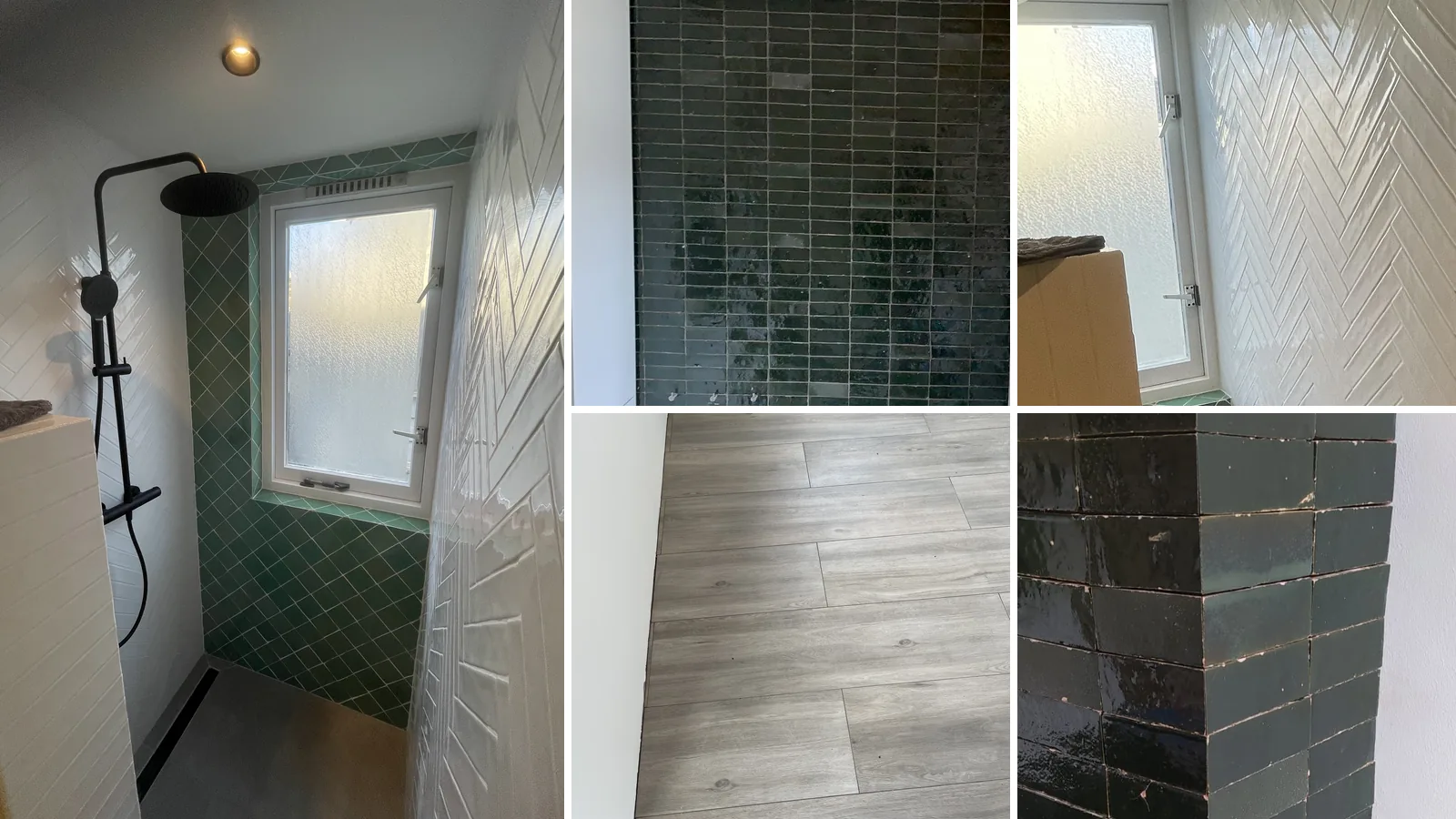
What a tiler costs per square metre in 2026
Starting prices for laying floor and wall tiles, what large formats and mosaic do to the rate, the preparation a quote adds before the first tile goes down, and a small bathroom worked through. The guides agree on the order of the lines and disagree on almost every number.
Laying tiles in a straight pattern starts at €30 per m² for labour in 2026, for floors and walls alike, according to the first of three Dutch price guides, here called A, B and C. Guide B starts walls at €35 and floors at €40, and Guide C starts a straight floor of tiles up to 60 × 60 cm at €18. Large tiles from 60 × 60 cm start at €45 per m², and mosaic or herringbone at €60. Those rates cover the laying only. The tiles themselves, removing the old ones, levelling the floor, waterproofing a bathroom and grouting are priced as separate lines, and in the bathroom worked through below they nearly double the cost of the laying.
Starting prices per m², in three 2026 guides
Guide A (a tiler cost guide, updated February 2026), Guide B (June 2026) and Guide C (a tiled floor guide, May 2026) publish their own ranges. The table shows the lower end of each, for labour without tiles. None of the three states if its figures include VAT, and Guide B tells readers to ask.
| Work | Guide A | Guide B | Guide C |
|---|---|---|---|
| Wall tiles, straight pattern | from €30 | from €35 | not given |
| Floor tiles, straight pattern | from €30 | from €40 | from €18 |
| Large format | from €45 (60 × 60 cm and up) | not given | from €30 (80 × 80 cm and up) |
| Mosaic or herringbone | from €60 | not given | from €30 (herringbone) |
| Removing old tiles | from €15, disposal included | from €15 | from €25 per hour |
| Levelling a floor | from €10 | from €10 | from €10 |
| Grouting | from €5 | from €8, with sealant joints | not given |
| Hourly rate | from €35 | from €35 | from €30 |
The site behind Guide A does not agree with itself. Its second guide, on tiling per m² and updated in April 2026, starts labour at €25 per m², removing old tiles at €10, levelling at €15 and the hourly rate at €30. Guide C sits lowest on floors because it prices a living room floor, which is open and flat and needs few cuts. A rate from one guide only compares with another when both describe the same room.
Floor or wall: which costs more per m²
Guide B puts wall tiling from €35 and floor tiling from €40 per m². The April guide agrees that walls are usually a little cheaper, because a floor needs more preparation and carries more load; the February guide prices both at one rate. As a total with the tiles, the April guide starts walls at €40 per m² and floors at €50, partly because ceramic floor tiles start at €20 per m² there and wall tiles at €15.
What moves a wall rate most is the number of interruptions: Guide B names niches, pipes, falls towards a drain and sealant joints as the reason a bathroom costs more per metre than a plain floor.
Large formats, mosaic and herringbone
Large tiles look like less work, since there are fewer of them, but the guides price them higher. Guide A gives more cutting and greater precision as the reason. Guide C starts a large ceramic floor at €70 per m² all in, against €50 for a standard ceramic tile. A flat floor matters more as the tile grows: Guide C puts the limit for tiling without levelling at a height difference of 3 mm over 2 metres.
Small tiles cost time. Guide A starts mosaic and herringbone labour at €60 per m², double a straight pattern. Guide C puts herringbone, hexagonal tiles and mosaic at 20 to 30 percent more labour, with 10 to 15 percent of herringbone material lost to diagonal cuts, and for a 40 m² living room puts the difference at €400 to €800.
Removing old tiles and levelling the floor
Replacing tiles costs more than tiling a new surface, Guide A notes, because demolition and disposal come on top. The February guide starts removal at €15 per m² with disposal included, and says the price depends on the adhesive and the surface underneath. Guide B also starts at €15 per m²; Guide C prices removal by the hour, from €25.
What the old tiles leave behind sets the next line. Guide C starts repairing the screed after demolition at €10 per m², and a skip at €100. Levelling compound starts at €10 per m² in all three guides and, Guide C notes, dries for 24 to 48 hours before tiling can start.
Waterproofing in a bathroom
In a shower or bathroom the tiles are not what keeps water out of the floor and walls. That is the job of a waterproof layer under them, with sealing tape (kimband) in the corners and around pipes. Guide A prices tape and sealing from €150 per job, and the April guide starts a complete bathroom, walls and floor with the waterproof layer included, at €70 per m². Guide B also starts bathroom tiling at €70 per m², preparation included. Our bathroom renovation cost guide covers the rest of the room, from pipework and drainage to sanitaryware.
Adhesive, grout and grout lines
The April guide puts adhesive and grout material at €8 to €20 per m², depending on the tile, and Guide C at €200 to €350 for a 40 m² floor. The February guide starts grouting work at €5 per m² for cement grout, rising to €15 for epoxy, which costs more and is easier to keep clean; Guide C recommends epoxy on kitchen floors. Narrow grout lines and special trim profiles also raise the price, according to Guide A.
Hourly rates and output per day
Most tiling is quoted per m² or as a fixed sum, with an hourly rate for small repairs and awkward details, says Guide B. That rate starts at €30 to €35 in the three guides, and Guide A notes that small jobs often carry a higher one. Guide C puts output at 15 to 20 m² a day on a living room floor in a straight pattern, and considerably less with herringbone or large formats.
Worked example: a small bathroom, floor and walls
A bathroom of 2 by 2 metres, tiled to a height of 2.5 m. The floor is 4 m². The walls are 8 m of perimeter times 2.5 m, or 20 m², less 2 m² for the door, which leaves 18 m². The old tiles come off the walls and floor. The walls get a standard ceramic tile in a straight pattern, the floor a 60 × 60 cm tile. Every rate is from Guide A, the February 2026 guide, so the lines share one set of assumptions.
- Removing old tiles, disposal included: 22 m² × €15 = from €330
- Levelling the floor: 4 m² × €10 = from €40
- Waterproofing, tape and sealing: from €150
- Wall tiles, straight pattern: 18 m² × €30 = from €540
- Floor tiles, large format: 4 m² × €45 = from €180
- Grouting: 22 m² × €5 = from €110
Total: from €1,350, or €61.36 per tiled m². The laying alone is €720, so the other lines add 88 percent. Guide A advises a reserve of 5 to 10 percent, which at 10 percent starts the budget at €1,485. Its own range for a bathroom of 6 to 10 m² starts at €1,500.
The tiles come on top. At the April guide’s starting prices, 20 m² of ceramic wall tile at €15 and 5 m² of large-format floor tile at €30 start at €450, the extra metres covering cuts and breakage. Whether tiles, adhesive and sealant sit inside a tiler’s price differs per quote, Guide B says, so a rate of €30 per m² and an all-in €90 can describe the same floor.
VAT: 21 percent on tiling, labour and tiles alike
Tiling carries 21 percent VAT, whatever the age of the home. The 9 percent rate for work on homes covers only insulating, painting, plastering and wallpapering in homes older than two years, plus cleaning, and the Belastingdienst states that other work on homes is taxed at 21 percent. On its plastering page it names applying tiles to walls and laying floors as examples of work that stays at 21 percent.
A bathroom often mixes the two. Plastering a wall before it is tiled falls under stukadoren, and in a home older than two years the 9 percent rate there covers the preparation and the materials as well as the labour. When one job contains both rates, the Belastingdienst says the quote and the invoice split them. Our article on the 9 percent rate goes through the other trades, and the plastering cost guide prices the wall work.
Apartments and older houses: check before the tiles come up
Two checks can stop a tiling job before it starts, and both are the homeowner’s responsibility. In an apartment, the VvE’s rules come first. A common clause in Dutch house rules (huishoudelijk reglement) allows hard flooring such as tiles in the living areas only on an underlay that improves contact noise insulation, often by at least 10 dB, and leaves kitchens and bathrooms out of that requirement. The wording differs per building, so read the splitsingsakte and the house rules, and get the board’s consent in writing before ordering tiles.
In a house built before 1994, have the old floor checked before it is broken out. Milieu Centraal lists tile adhesive among the materials that can contain asbestos, and notes that vinyl floor tiles reinforced with asbestos were sold until about 1985.
LucKey Construction, based in Zaandam, lays floor and wall tiles in Amsterdam, Haarlem, Alkmaar, Purmerend, Amstelveen and elsewhere in North Holland: bathrooms, kitchens, showers and splashbacks, in ceramic, porcelain, natural stone, mosaic and cement tiles. Every job is measured on site first. The detailed quote that follows describes the work, the materials and the expected duration, and lists what the client buys and how much of it: raw construction materials are supplied by LucKey and included in the offer, while visual and decorative materials are provided by the client. The work area is cleaned every day, the work carries a one-year warranty, and the company is insured against accidental damage. See tile installation, or ask for a quote.
Disclaimer: every figure in this article is a starting point, not a price and not a ceiling. They are national market indications for 2026, drawn from published Dutch price guides and observation of the Amsterdam region, and they describe where work of this kind begins when nothing unusual is found. They are not a quotation, a price list or an offer, and no figure here can be relied on for any particular project. What tiling actually costs depends on the property, the size and shape of the rooms, the condition of the existing floors and walls, the tiles and pattern chosen, the preparation needed and the region, and it is fixed only in a written quotation after a property visit and a full calculation. That quotation is the only figure that binds anyone. Labour rates and material prices change, and the figures here reflect the position in October 2026. Rules on VAT and on what a VvE allows change and differ: check anything here that affects a tax rate with the Belastingdienst, and anything that affects an apartment with your VvE and its house rules. Responsibility for consents and applications rests with the homeowner, not with the contractor.