
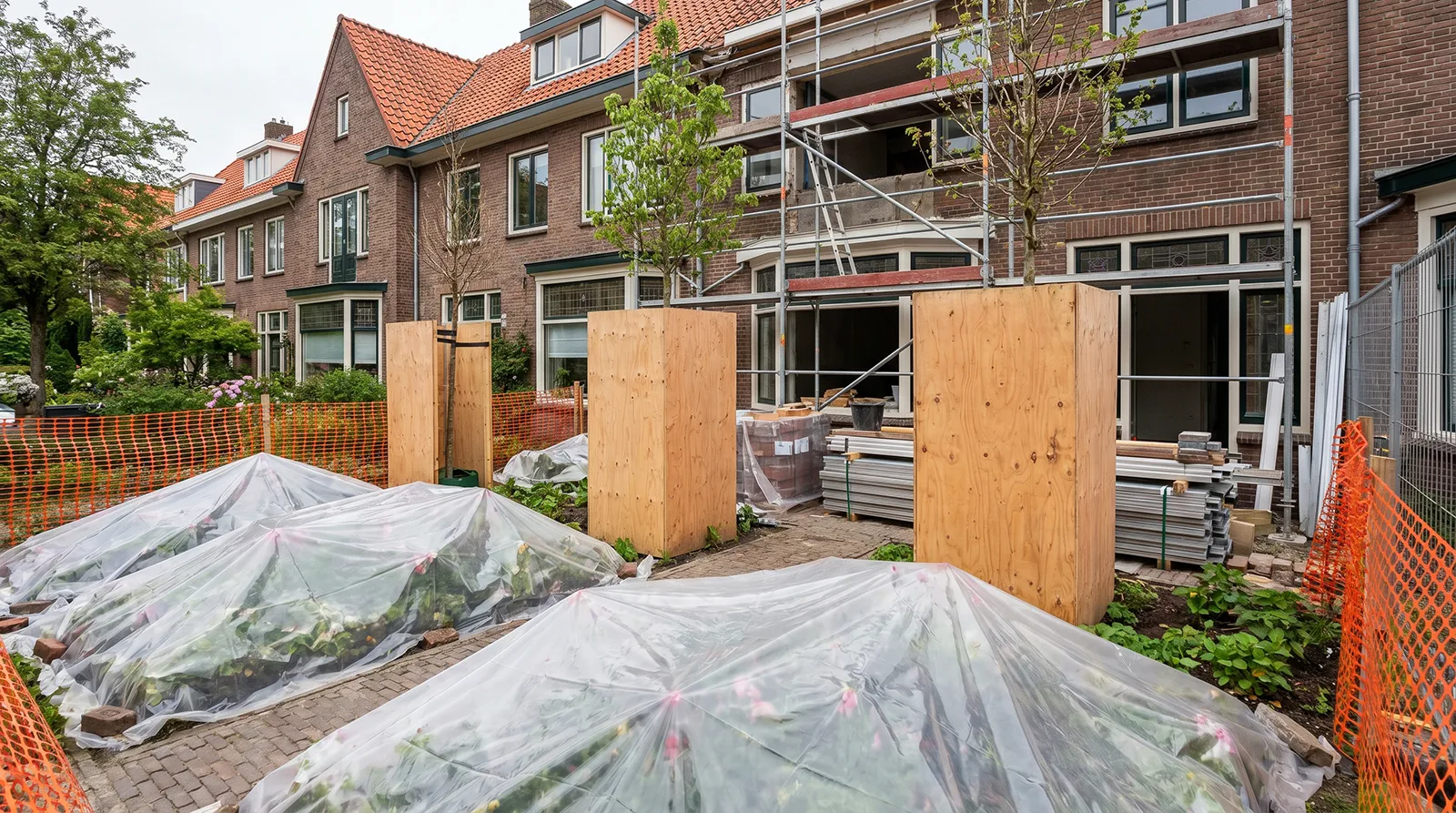
How to Save Trees, Fences and Planting
Protecting your garden during a renovation in the Netherlands rarely gets the attention the house does. Yet a major renovation seldom stays within the walls. Scaffolding needs ground space. Materials arrive by van. Demolition waste has to leave somehow, and workers need safe access. Before long the garden turns into a storage zone, a walkway and, if nobody plans for it, the first casualty of the project.
For Dutch homes this risk is familiar. Gardens are often compact, fences sit close to neighbours, mature trees may stand near the facade, and rear access can be awkward. In older city homes a small garden may be the only practical route for materials. In suburban properties a front garden quickly becomes the landing area for machinery, sand, insulation, timber, scaffolding parts and waste containers.
Garden protection during renovation is not about being precious. It prevents avoidable damage to living systems: roots, soil, plants, drainage, paving, fences and boundary structures. Once heavy loads compact a garden or careless storage damages it, recovery can take months or years.
Plan garden protection before work starts
In the Netherlands, building and renovation work sits within a regulated environment. Projects must comply with the Besluit bouwwerken leefomgeving (Bbl) and the local omgevingsplan. Depending on the work, you may also need an omgevingsvergunning or a notification. Business.gov.nl’s guidance “Environment and planning permit for building” is clear: most building, rebuilding or renovating needs an environment and planning permit, and only some activities are permit-free.
This matters for gardens because exterior works rarely stay separate from the wider project. A house extension, facade renovation, dormer, foundation repair or major interior renovation can all affect access routes, trees, fences and outdoor drainage.
The best time to protect a garden is during the planning phase, not after the first cracked slab. That is when the contractor, homeowner and any specialists agree where materials go, where workers walk, how scaffolding stands, and which parts of the garden stay off-limits.
For larger renovations, garden protection belongs in the work plan: protected zones, storage zones, waste routes, scaffold positions, temporary ground coverings and tree measures.
Protecting trees during a renovation
A mature tree can look tough, but most construction damage happens below ground. Trenching can sever roots, compacted soil suffocates them, spilled chemicals poison them, and materials stacked above them cut off their oxygen.
Dutch tree guidance has become more structured in recent years. Norminstituut Bomen launched Handboek Bomen 2026 on 21 May 2026 and updated the professional framework for tree care. Its instrument overview “Handboek Bomen” sets out standardised quality requirements, guidelines and norms for work in, around and with trees.
The principle is simple: protect the ground under and around the canopy, not only the trunk. Tree-care practice ties the protected area to the crown projection, the outline of the canopy on the ground, plus a buffer. Municipal tree ordinances often set a boombeschermingszone of the crown projection plus about two metres. Once work or digging reaches that zone, you usually need a Boom Effect Analyse (BEA) and the tree manager’s approval before machinery moves in.
So keep tiles, cement bags, wheelbarrow routes and temporary parking away from the trunk and the roots beneath the canopy. Where a tree stands close to the works, fixed fencing protects it better than movable tape.
The City of Utrecht’s “Boombescherming op de bouwplaats” gives a concrete example. The city advises fixed construction fencing at least one metre outside the crown projection, propped where needed, and it forbids fixing anything to trees with nails, screws, straps or clamps.
Tree permits: when you need permission
Not every garden tree can go just because it is in the way. Dutch rules vary by municipality, and protected or mature trees may need permission.
Business.gov.nl’s “Environment and planning permit: felling trees” sets out the basics. Cutting down, moving or drastically pruning trees inside the municipality’s built-up tree-felling area (bebouwingscontour houtkap) can require an environment and planning permit. Whether you need one depends on the number of trees, their height or diameter, any special value, and how much you prune. You will find the rules in the local environment plan, the tree-felling ordinance and the APV.
There is also a nature duty. Felling can harm birds, animals and plants. The same guidance notes that work in the breeding season, 15 March to 15 July, needs checks in advance, and sometimes a permit for flora and fauna activities.
For homeowners the message is simple. Before you remove, move or heavily prune a tree, check the Omgevingsloket and your municipal rules. The permit duty normally sits with the property owner, not automatically with the contractor.
Protecting fences and boundaries
A damaged fence may look minor next to a structural renovation, but it can quickly turn into a neighbour problem. Dutch gardens sit close together, and shared boundaries are sensitive.
Before work starts, photograph the condition of fences, gates, walls and shared boundaries with a date. Agree which gate the crew will use. If you must remove panels to bring in materials, agree first how the crew will store, protect and reinstate them.
For fragile wooden fencing, temporary site barriers or protection boards in front of the fence beat hoping workers will avoid it. Where machinery, scaffolding or deliveries pass close to a boundary, a little protection prevents scratched paint, cracked posts and strained relations.
This matters most for rear extensions, facade work, garden rooms and foundation projects, where the crew needs repeated access through narrow passages.
Protecting soil from compaction
Soil damage is one of the least visible renovation problems. A garden can look intact at the end of the job, yet compacted soil leaves plants struggling for years, with rainwater draining poorly, roots starved of air, patchy lawns and failed new planting.
The cause is usually simple: repeated walking, wheelbarrows, scaffold feet, compact machinery or storage in one spot.
The fix is to define routes. Cover the construction route with temporary ground protection, such as heavy-duty boards or mats, on lawns, beds and soft soil especially. Spread loads instead of concentrating them. Where scaffolding goes up, base plates and protective underlayers limit local damage.
Gardens on clay or peat soil, common in parts of the Netherlands, need even more care. Wet soil compacts easily, and a route that seems harmless in summer can turn destructive during a rainy autumn or winter renovation.
Material storage during renovation
A renovation needs materials near the work, but poor storage can ruin a garden in a weekend.
Keep bricks, plasterboard, insulation, timber, cement, tiles and metal profiles on agreed hard surfaces where you can, not on beds or root zones. If the garden is small and you cannot avoid storing on planted areas, use load-spreading boards and keep it short.
Chemicals, paint, primer, sealants and wet materials need extra care. Never let spills seep into soil, drains or beds. Mixing mortar or cutting materials over bare ground does the same harm, because dust and slurry change soil quality and stain paving.
A well-run renovation site looks organised, and that is what keeps the garden safe.
Scaffolding and the garden
Facade renovation, roof work, painting, window replacement and extensions often need scaffolding. Plan the scaffold around the garden, not only the wall.
Ask where the legs will stand, what lies beneath them, what has to move, and how water will drain while the scaffold is up. Scaffold feet crack paving and sink into soft ground, and they crush plants and roots when placed carelessly. Protective boards and load-spreading plates are simple safeguards. Detach climbing plants carefully rather than cutting them back hard. Identify gutters, garden lighting, irrigation pipes and outdoor sockets before the scaffold goes up.
If the scaffold stays for weeks, check that plants beneath it still get water. Rain may not reach covered ground, even in a wet Dutch month.
Protecting existing planting
Not every plant survives in place. Lift and move some shrubs and perennials before construction starts. Cut back others at the right time of year and protect them.
The plants most at risk sit near access routes, scaffold lines and storage areas, where the crew can trample, break or bury them, or where shifts in light and water damage them. Move large pots off the site route. Mark delicate climbers, young trees and hedges clearly.
A gardener or landscape specialist can say which plants are worth moving, which to prune, and which will not survive the disturbance. For high-value planting, protecting it properly usually costs less than replacing it later.
Drainage, paving and garden levels
Renovations change how water moves around a property. A new extension, terrace, facade insulation system, garden room or altered threshold can affect drainage. Change garden levels without thinking and rainwater runs toward the house instead of away from it.
This matters in the Netherlands, where heavy rainfall and tight urban plots strain drainage. Keep paving sloping correctly and drainage channels clear. Do not pile soil against timber, facade openings or damp-sensitive walls.
After a renovation, do not simply put the garden back. Check it as part of the finished property: does water drain properly, can you reach inspection points, are the fences stable, and did the protected trees and plants survive?
Landscaping after renovation
Even with good planning, a major renovation often leaves the garden tired. The question is whether it needs minor recovery or a redesign.
Light damage may call for aeration, compost, lawn repair, paving cleaning and a few new plants. Heavier damage may need soil improvement, new beds, drainage correction, fence repair, terrace relaying or full landscaping.
A renovation also opens a door. If the house has changed, the garden may need to change with it. A new rear extension shifts the link between kitchen and terrace. New doors move the walking route. A renovated facade can make old paving look wrong. A good post-renovation garden is not just repaired; it works with the new home.
Working with the right contractor
Garden protection is partly technical and partly cultural. It depends on whether the team treats the outdoor space as part of the property, not a convenient building zone.
Before work starts, ask how the crew will manage access, where they will store materials, how they will protect trees, whether fencing or paving needs cover, and how they will remove waste. For Dutch homeowners planning substantial construction or renovation, a professional team such as LucKey Construction brings these decisions into the project plan instead of leaving them to chance.
Discuss the garden before the first delivery arrives, not after the lawn vanishes under pallets.
Final thoughts
A renovation should improve a home, not leave the garden as collateral damage. In Dutch properties, where outdoor space is limited and valuable, garden protection during a renovation has to be deliberate: check permit duties, respect tree protection zones, plan access, protect soil, store materials sensibly, shield fences and think about landscaping from the start.
The difference is not only visual. It affects drainage, biodiversity, neighbour relations and how the finished home feels once the builders leave. The house may be the main project, but the garden is part of the home, and protecting it is good renovation practice.