
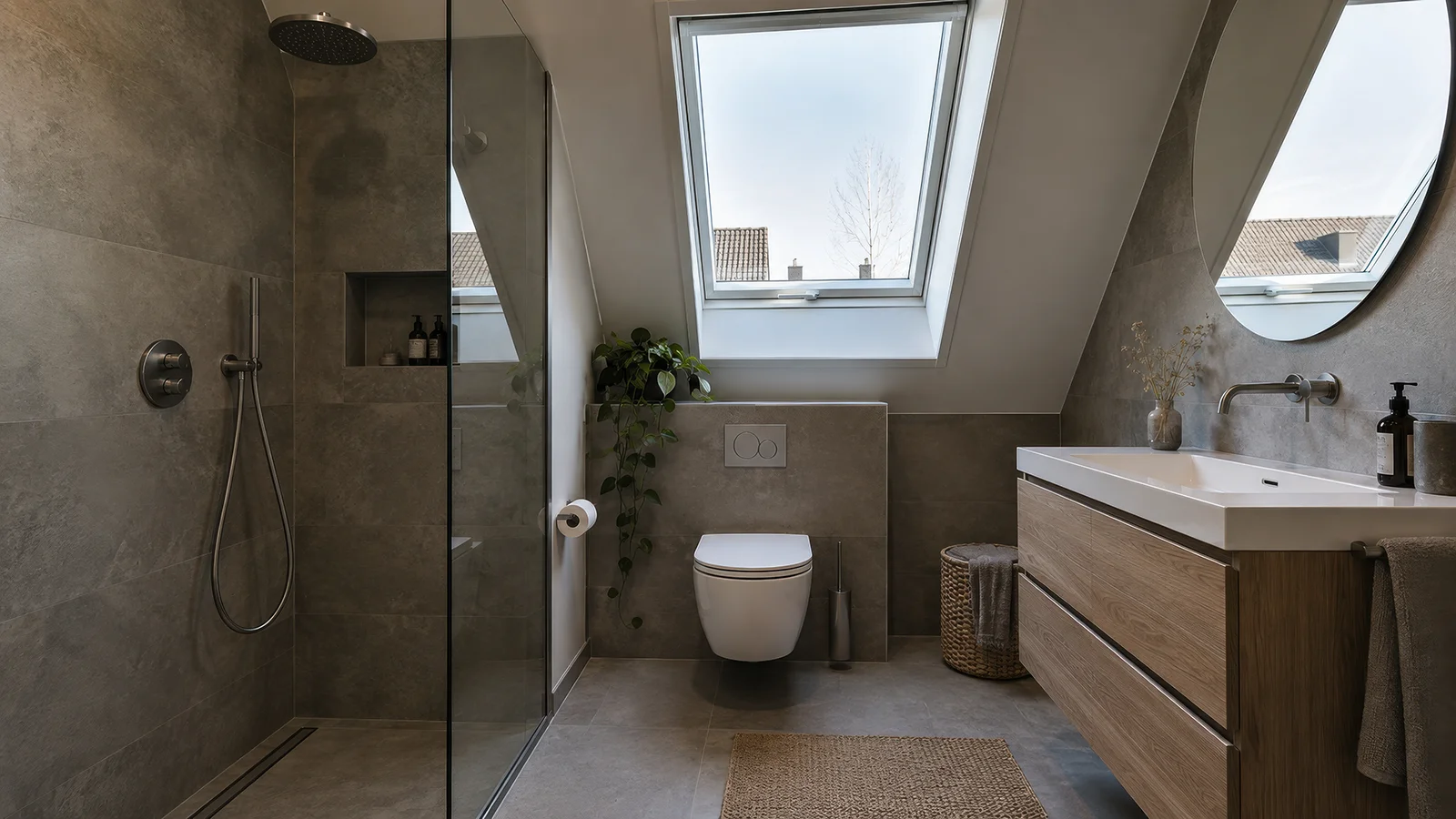
What a bathroom renovation starts at in the Netherlands in 2026
Published Dutch guides start the same job at €3,500 and at €8,000. Both figures are correct. The distance between them is a difference in what is being quoted, not a difference of opinion about prices.
Search for the cost of a bathroom in the Netherlands and two sets of numbers come back. One family of guides opens a complete renovation of about 9 m² at €3,500, and the price per square metre at €500. Another opens the same description at €8,000, and at €1,200 per m². The two starting points are more than double apart.
They are not measuring the same work. The lower set describes replacing what is in the room: out with the old sanitaryware and tiles, in with the new, pipes and cabling left where they are. The higher set describes rebuilding the room: new pipework and drainage, a new electrical group, mechanical ventilation, waterproofing, underfloor heating, sometimes a moved wall. The first is a refit. The second is a renovation. Almost every argument about bathroom prices is really an argument about which of the two is being quoted.
What each level of budget actually buys
| Level | Total, about 9 m² | Per m² | What it covers |
|---|---|---|---|
| Refit | from €3,500 | from €500 | New sanitaryware and tiles in the existing layout, existing pipework |
| Mid-range | from €5,000 | from €700 | Better materials, a walk-in shower, some pipework moved, new ventilation |
| Full renovation | from €8,000 | from €1,000 | Room stripped to the shell, new pipes, cabling, waterproofing, underfloor heating |
| High end | from €15,000 | from €1,200 | Layout changed, natural stone or large-format tile, designer sanitaryware, built-in systems |
Small bathrooms cost more per square metre, not less. A 4 m² room still needs a drainage stack, a shower drain, waterproofing, a tiler and an electrician. The fixed part of the work is spread over fewer metres, so a compact Amsterdam bathroom starts at a higher figure per square metre than a generous suburban one, even when the specification is identical.
The line items, priced
Most Dutch quotes are built from the same components, and knowing where each one starts makes an unusual number easy to spot.
- Strip-out and waste removal: from €500. Higher in an apartment with no lift and a narrow stair.
- Plumbing and electrics: from €800.
- Tiling and finishing: from €1,500.
- Sanitaryware, all of it: from €1,000.
- Shower: from €500. Bath: from €700. Toilet: from €450. Basin: from €200. Tap: from €150.
- Floor: from €700.
- Electric underfloor heating: from €755 for a normal bathroom.
- Whirlpool or spa bath: from €2,700. Steam cabin: from €1,600.
Add the starting figure of the lines a complete bathroom always needs, which is strip-out, pipework and electrics, tiling, sanitaryware and floor, and you are at about €4,500 before a single choice has been upgraded. Every decision after that moves in one direction.
Where the money goes
Labour is the largest single share of a bathroom, at 40 to 50 percent of the total. Sanitaryware and tiles together take about 35 percent, strip-out and disposal around 10, and a contingency of about 10 percent belongs in the budget whether or not the quote shows one.
That balance explains why cutting the material spend disappoints people. Choosing a basin at €400 instead of one at €800 saves €400 on a job of several thousand. Changing the layout, so that the shower drain moves to the other side of the room, can add several times that in floor breaking, drainage falls and a second tiling day. Layout changes drive the total. Fittings move it much less than the showroom suggests.
The part behind the tiles
In Dutch houses built before roughly 1980, the bathroom is where three old systems meet. Galvanised or lead supply pipes, a drainage stack shared with the kitchen, and a lighting circuit with no earth and no residual current device. A refit tiles over all three. A renovation replaces them.
Water damage in an apartment reaches the neighbour below, and the bill follows. Waterproofing under the tiles, a correctly built shower floor with a fall towards the drain, and mechanical extraction sized for the room are not upgrades, they are the reason the room lasts fifteen years instead of five. Where a quote is unusually cheap, this is normally what is missing from it. Our pages on plumbing and electrical work set out what a compliant rebuild involves.
Apartment owners face one more gate. Work touching the stack, the structure or the sound insulation needs the VvE’s agreement, and asking for it after the tiler has started is an expensive way to learn the rules.
Amsterdam, and what location does to the price
One Dutch pricing index puts labour rates roughly 3 percent above the national level in smaller cities and up to 15 percent higher in Amsterdam and Utrecht. On a bathroom that started at €8,000 that is €1,200 of difference before anything has been specified.
The city adds practical costs as well as rates. A canal house with a stair too tight for a bath, no place to park a skip, a permit for the loading bay, and a floor that has to be surveyed before heavy tile goes down. None of it appears on a national price guide, and all of it appears on an Amsterdam quote. It is the reason a bathroom in Zaandam and the same bathroom in the Jordaan are not the same job.
VAT, and the one line that can legally drop to 9 percent
Bathroom work carries 21 percent VAT. The Dutch reduced rate of 9 percent is limited to five activities on homes older than two years: insulating, painting, plastering, wallpapering and cleaning.
Two of those turn up in a bathroom. Plastering the walls before tiling falls under stukadoren, and there the 9 percent rate covers the material as well as the labour. Insulating an external bathroom wall falls under isoleren, where 9 percent applies to the labour while the insulation material stays at 21. Tiling, plumbing, electrics and sanitaryware are all 21 percent. A quote that splits those lines is charging the rate the law allows. A quote with one round number is not. Our note on VAT during a renovation goes through the boundaries.
How long you will be without a bathroom
A straightforward refit runs about a week. Most complete renovations take one to three weeks. Large or complicated rooms run three to five. The calendar is set less by the work than by the waiting inside it: screed and levelling compound have to dry, tile adhesive and grout have to cure, and paint needs the room ventilated afterwards.
Two things reliably add a week. Sanitaryware ordered late, because a delivery time of four to six weeks on a specific model stops everything behind it. And a discovery in the first two days, when the floor comes up and the drainage turns out to run somewhere other than where everyone assumed. Ordering the sanitaryware before demolition begins removes the first. The contingency covers the second.
Keeping control of the number
What keeps a bathroom budget where it started is mostly ordinary discipline.
- Decide the layout first and freeze it. Moving the drain after the floor is open is the single most expensive change available.
- Ask for the quote split into strip-out, pipework, electrics, waterproofing, tiling, sanitaryware and finishing. A single total cannot be compared with anything.
- Buy the sanitaryware early, and check the delivery time before the specification, not after.
- Hold 10 percent back for what the floor hides. In a pre-1980 house, treat it as likely rather than possible.
Compact rooms have their own logic, and we have written separately about making a small Dutch bathroom work and about designing one to stay usable later in life.
Where the honest number starts
Replacing what is in a Dutch bathroom of about 9 m² starts at €3,500. Rebuilding the room properly, pipes and all, starts at €8,000. Changing the layout or specifying stone and built-in systems starts at €15,000. Per square metre the honest starting figure is €500 for a refit and €1,000 for a rebuild, with small rooms beginning higher than large ones. Where a particular room lands above its starting point comes down to the layout, and to whatever the old tiles turn out to be hiding.
LucKey Construction renovates bathrooms in Zaandam, Amsterdam, Haarlem and the surrounding towns, and quotes them line by line, with strip-out, pipework, electrics, waterproofing, tiling and sanitaryware separated so the 9 and 21 percent portions are visible and the contingency is a number rather than a surprise. See bathroom renovation. Which permissions or VvE consents a job is likely to need is flagged at the quotation stage. Submitting them stays with the homeowner.
Disclaimer: every figure in this article is a starting point, not a price and not a ceiling. They are national market indications for 2026, drawn from published Dutch price guides and observation of the Amsterdam region, and they describe where work of this kind begins when nothing unusual is found. They are not a quotation, a price list or an offer, and no figure here can be relied on for any particular project. What the work actually costs depends on the property, the size and shape of the room, the condition of the existing pipework and electrics, the materials chosen and the region, and it is fixed only in a written quotation after a property visit and a full calculation. That quotation is the only figure that binds anyone. Labour rates and material prices change, and the figures here reflect the position in September 2026. Rules on permits, subsidies and VAT change: check anything here that affects a permit, a subsidy or a tax rate with the body responsible for it, which means your municipality and the Omgevingsloket for permits, RVO for the ISDE, and the Belastingdienst for VAT. Responsibility for permits and applications rests with the homeowner, not with the contractor.